

Charles Edward Bradley born
Ó Brolcháin

Charles Edward Bradley, whose birth name was Ó Brolcháin, was born on the 26th March 1750 in Ballinascreen, Londonderry, Northern Ireland.
He died on the 9th of April 1826 in 'McGuire's Settlement', now called Loretto, Cambria County, Pennsylvania. USA.
He married Mary Ann Potter-Johnstone in 1793. She was the daughter of Marquess George Harold Johnstone of that Ilk Born 22 May 1737 in Ecclefechan, Dumfries and Galloway, Scotland. They had 15 children in 22 years.
Wife:
Mary Anne Bradley née Johnstone 14 October 1757 –1817
Children:
William Owen Bradley 1778–1846
Alice née Bradley 1781–1844
Thomas Adag Bradley 1782–1857
Mary Janet née Bradley 1783–1853
Edward McGuire Bradley (Neason) Adopted 1785–1829
Dennis Patrick Bradley 1787–1857
William Michael Owen Charles Bradley born Ó Brolcháin 1792–1849
Charles Ryan Bradley / McGuire 1795–1855
John James Bradley 1796–1876
Elizabeth née Bradley 1797–1849
Martha Ann née Bradley 1798–1838
Joseph Bradley 1800-1846
Charles Bradley (McGuire) Adopted 1793–1855
James George Bradley 1801-1876
Dorothy Aillen née Bradley 1801-1869
Charles Bradley, the son of Flann Adag O'Brolchain, a notable figure in the American Revolutionary War. He married Lady Mary Anne Johnstone and is noted for helping to build the first church in western Pennsylvania for Prince Demetrius Galitzin.
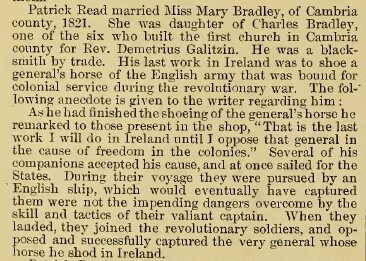
Picture of Charles Bradley and of a clipping from the Cambria County Historical Society of Cambria County, Pennsylvania
Mary Bradley was the daughter of Charles Bradley as described in this clipping.
Charles Bradley Citizenships papers from 1798

Major Charles Edward Bradley (Born O'Brolchain) 1750–1826
He settled in McGuire's Settlement now called Loretto, Pennsylvania. He is buried in:
Saint Michael Cemetery in Loretto, Cambria County, Pennsylvania, USA
He served in the American Revolutionary War alongside that of Captain Michael McGuire
Michael McGuire | Cambria Memory Project
and
Colonel Brown who was Captain McGuire's father-in-law, Georgia Loyalist Colonel Thomas Brown led his King’s Rangers and was the British Superintendent of Indian Affairs for the southern colonies. Until the American Revolutionary War had began and Swore Loyalty to General Washington.
Colonel Thomas ‘Burnfoot’ Brown – Revolutionary War Journal
Major Charles Edward Bradley had a story attached to him of Capturing a British General while he was in service during the American Revolutionary War. He was also one of 6 men that built the first church for Prince Demetrius Gallitzin Father of the Catholic faith in the Pennsylvania wilderness; aka "The Apostle of the Alleghenies".
This is the tie to his friend, a fellow Prince!
https://en.wikipedia.org/wiki/Demetrius_Augustine_Gallitzin
http://demetriusgallitzin.org/
Demetrius Augustine Gallitzin
From Wikipedia, the free encyclopedia
Servant of God
Prince Demetrius Augustine Gallitzin
Born 22 December 1770
The Hague, South Holland, Netherlands
Died 6 May 1840 (aged 69)
Loretto, Pennsylvania, United States
Prince Demetrius Augustine Gallitzin (December 22, 1770 – May 6, 1840) was an emigre Russian aristocrat and Catholic priest known as
"The Apostle of the Alleghenies" and also in the United States as Prince Galitzin.
He was a member of the House of Golitsyn.
Since 2005, he has been under consideration for canonisation by the Catholic Church.
His current title is Servant of God, granted by Pope Benedict XVI in 2005.
Early life
Prince Gallitzin was born into nobility on 22 December 1770 at The Hague. His father, Prince Dimitri Alexeievich, the Russian ambassador to the Netherlands, was an intimate friend of Voltaire and a follower of Diderot. His mother was the Prussian Countess Adelheid Amalie von Schmettau, the daughter of Field Marshall Samuel von Schmettau. Yelizaveta Golitsyna, a member of the Society of the Sacred Heart, was a maternal first cousin.
When Prince Demitri was about two years old, the Empress Catherine the Great visited The Hague, and as a sign of special favour to his father, cradled the child in her arms and appointed the boy an officer of the guard. He was raised as a nominal member of the Russian Orthodox Church, although his father, like many Russian aristocrats of his age, had little connection to or fondness for religion. As was fashionable at the time, the household's language was French, which was Prince Dmitri's native tongue.
In his youth, his most constant companion was William Frederick, son of William V, then reigning Stadtholder of the Netherlands. This friendship continued even after William became King of the Netherlands and Duke of Luxembourg as William I. Each summer, his mother would take Dimitri and his sister travelling to the principal cities of Germany, explaining to them important geographical or historical features. Demetri was, by nature, rather reserved and timid. His sister made friends more readily, but Dimitri kept them longer.
After his mother's return to Catholicism in 1786, he was greatly influenced by her circle of intellectuals, priests, and aristocrats. At the age of 17, Prince Dimitri was formally received into the Catholic Church. To please his mother, whose birth (1748) and marriage (1768) occurred on 28 August, the feast of Saint Augustine, he assumed at the confirmation that name, and after that wrote his name Demetrius Augustine.
A cousin, Elizabeth Gallitzin, would also eventually convert and join the Society of the Sacred Heart, founding several religious houses in the United States.
His father, who had been planning a military career for him, was quite unhappy with the change and was barely dissuaded from sending his son to Saint Petersburg, where he hoped a stint in a Russian Guards Regiment would force his son back into Orthodoxy. In 1792, his son was appointed aide-de-camp to General von Lillien, the commander of the Austrian troops in the Duchy of Brabant; but, after the death of Leopold II of Austria and the murder of King Gustav III of Sweden, Prince Dimitri, like all other foreigners, was dismissed from Austrian Service.
America
As was the custom among young aristocrats at the time, he then set out to complete his education by travelling. As the French Revolution had made European tours unsafe, his parents resolved that he should spend two years travelling through America, the West Indies, and other foreign lands. His mother provided him with letters of introduction from the prince-bishops of Hildesheim and Paderborn to Bishop John Carroll of Baltimore. With his tutor, Father Brosius, afterwards a prominent missionary in the United States, he embarked from Rotterdam on18 August 1792, and landed in Baltimore on 28 October. To avoid the inconvenience and expense of travelling as a Russian prince, he assumed the name of Augustine Schmettau. This name then became Schmet or Smith, and he was known as Augustine Smith for many years after.
Conewago Chapel, Adams Co. PA
Not long after his arrival, he became interested in the Church's needs in the United States. To the shock and horror of his father, Prince Dimitri decided to join the priesthood and offered to forgo his inheritance. The Ambassador subsequently persuaded Catherine the Great to award his son a commission in one of the Palace Guards Regiments and formally summoned him to active duty in St. Petersburg.
Demetrius Augustine Gallitzin entered the newly established Seminary of St. Sulpice in Baltimore on 5 November 1792.
Father Gallitzin was ordained on 18 March 1795 by Archbishop Carroll. Gallitzin was the first to make all his theological studies in the United States. Gallitzin was sent to work in a church mission at Port Tobacco, Maryland, whence he was soon transferred to the Conewago district, where he served at Conewago Chapel until 1799. His missionary territory extended from Taneytown, Maryland, to Martinsburg, then in Virginia, and Chambersburg, Pennsylvania. In 1794, Gallitzin travelled to Middleway, West Virginia, near Martinsburg, to accompany Father Dennis Cahill in the investigation of a haunted-house phenomenon known locally as the Wizard Clip. Gallitzin wrote of this experience much later, around 1839.
Missionary
In the Allegheny Mountains, in 1799, Gallitzin founded the settlement of Loretto, Pennsylvania, in what is now Cambria County, Pennsylvania. In turn, Loretto was an expansion upon a small clearing, "the McGuire Settlement," established by Captain Michael McGuire in 1788.
McGuire, who died in 1793, bequeathed 400 acres (160 ha) in trust to Bishop Carroll to launch a full Catholic community with resident clergy. Gallitzin's military training had taught him engineering fundamentals, and in 1816, he marked out Loretto on the southern slope of a pleasant hillside. He named the town after the place of Marian devotion in Italy.
With Gallitzin in the lead, Loretto became the first English-speaking Catholic settlement in the United States west of the Allegheny Front.
Gallitzin dedicated Loretto's parish church to the honour of St. Michael the Archangel, both as a nod to Gallitzin's Russian roots and, indirectly, to Michael McGuire. For several years, St. Michael's Church was the only Catholic Church between Lancaster, Pennsylvania, and St. Louis, Missouri. The church today is known as the Basilica of St. Michael the Archangel.
In 1802, Gallitzin became a naturalised citizen of the United States under the name Augustine Smith. Seven years after he was naturalised and became a citizen of the United States, an Act passed by the General Assembly of Pennsylvania authorised him to establish his name,
Demetrius Augustine Gallitzin, and to enjoy all of the benefits accruing to him under the name Augustine Smith.
In the Alleghenies
It was a 150-mile (240 km) sick call that first brought Father Gallitzin to "the McGuire settlement." After he was established in Loretto, if a sick call was within a few miles of wherever he was staying, he travelled on foot. For the last four years of his life, he travelled by sledge because a fall prevented him from riding horseback. When Gallitzin first started, there were few families, and those were widely scattered.
He bought land to attract other Catholic settlers. Gallitzin is believed to have spent $150,000 (USD) of his funds to purchase an additional 20,000 acres (81 km2), which he gave or sold at low prices to newly arriving Catholic settlers. Travelling from one valley to the next, he was often away for over a week, sleeping on bare floors. For most of his time in the mountains, he worked alone and was relatively isolated. In September 1807, he wrote to Bishop Carroll:
...I am hardly recovered from a severe spell of sickness which attacked me in Greensburg and which has left me so weak I can scarcely crawl about... My constitution being weak, and my heart perhaps too susceptible of deep impressions from disappointments, losses, &c., I have been wonderfully low this great while, ...I can better feel than describe the gloomy and melancholy state of my mind, especially since the death of my mother. ...my own solitary situation in the wilderness of the Allegheny, my sufferings and persecutions here, conspire to overwhelm me with sorrow and melancholy. ...for God's sake, send me a companion, a priest, to help and assist me, -a friend to help me bear the burden.
Lost inheritance
Over the years, Gallitzin had received some money from his mother, Princess Gallitzin. From time to time, he borrowed against his expected inheritance. Upon his father's death, Father Gallitzin, as a Catholic priest, was not allowed, according to Russian law, to receive the estate from his father. His representatives in Europe assured him this was not an insurmountable problem, and his sister Maria Anna had pledged to see that he received his share. However, circumstances changed when her subsequent marriage to an insolvent German prince absorbed most of the estate, although he did receive periodic remittances from her. William I of the Netherlands was persuaded to purchase some valuable items from Princess Gallitzin's estate with the understanding that the proceeds were to be sent to his old friend. However, the funds were delivered to Gallitzin's brother-in-law, and he saw little of it. His sister bequeathed him an annual stipend, but he saw little of that either.
Gallitzin was often encouraged to return to Europe to claim his rights. Still, as he was reluctant to abandon his flock, he left the matter in the hands of his representatives, who were sometimes less than assiduous.
He soon found himself deeply in debt. Besides land, he had provided his parishioners with a grist mill and sawmill to help the community prosper. He obtained a loan from Charles Carroll. Cardinal Cappellari, afterwards Pope Gregory XVI, donated two hundred dollars.
The Russian ambassador to the United States loaned him $5,000 and then used the promissory note to light his cigar. Later, when Gallitzin was suggested for the see of Philadelphia in 1814, Bishop Carroll objected. Carroll agreed that Gallitzin's debts had been contracted for excellent and charitable purposes. Still, it was not clear that Gallitzin had the financial acumen to run a diocese as important as Philadelphia, Carroll believed. In 1815, Gallitzin was suggested for the bishopric of Bardstown, Kentucky, and in 1827 for the proposed see of Pittsburgh. Gallitzin resisted proposals to nominate him the first bishop of Cincinnati and the first bishop of Detroit, but he did accept appointment as Vicar-General for Western Pennsylvania. By the end of his life, he had eradicated the debts incurred in building the community.
Writings
Notwithstanding his various duties, Father Gallitzin found time to publish several tracts in defence of Catholicism. He was provoked to respond to a sermon delivered on Thanksgiving Day 1814, in Huntingdon, Pennsylvania, by a particular minister who went out of his way to attack what he called "popery." Father Gallitzin first published his Defence of Catholic Principles, which ran through several editions. This was followed by A Letter on the Holy Scriptures and An Appeal to the Protestant Public.
Quotes
Whatever differences on points of doctrine may exist amongst the different denominations of Christians, all should be united in the bonds of charity, all should pray for one another, all should be willing to assist one another; and, where we are compelled to disapprove of our neighbour's doctrine, let our disapprobation fall upon his doctrine only, not upon his person.
Death
Dimitrius Gallitzin marker
For 41 years, Gallitzin travelled the Allegheny Mountains, often in challenging conditions, preaching, teaching, serving, praying, and offering the sacraments. A doctor had recommended bed rest and warmth for the exhausted priest, but he was reluctant to curtail any Lenten or Holy Week services. Father Gallitzin ministered faithfully until the very end of his life, and after a brief illness, died at Loretto on May 6, 1840, shortly after Easter. He was buried near St. Michael's church in Loretto.
Family
In 1805, Gallitzin was appointed by the Orphans' Court of Somerset County, Pennsylvania, to be the legal guardian of six "minor children of Francis McConnell, dec'd". They ranged in age from two years to "between ten and eleven," and were named beneficiaries in his will.
served alongside officers such as Captain Michael McGuire and Colonel Brown (Index
Service Highlights
- Continental Army Engagement:
- Bradley’s service was part of the broader effort by American colonists to secure independence from British imperial rule.
- During the war, he participated in active military campaigns against British forces in North America, contributing to the Continental Army’s
operations that ultimately achieved American victory.
- Notable Military Feat:
- A story associated with Major Bradley recounts the capture of a British general, suggesting he was directly involved in engagements that had strategic importance, likely involving skirmishes or coordinated assaults against high-ranking British officers (Index
1). This anecdotal account, while not fully corroborated by primary military archives, aligns with typical narratives of commissioned officers who engaged in localized actions during the Revolution.
- A story associated with Major Bradley recounts the capture of a British general, suggesting he was directly involved in engagements that had strategic importance, likely involving skirmishes or coordinated assaults against high-ranking British officers (Index
- Historical Context:
- The American Revolutionary War lasted from April 19, 1775, to September 3, 1783, concluding with the Treaty of Paris, in which Britain recognized U.S. independence (Index
1). Officers like Bradley operated in a complex theater including the Eastern Seaboard, parts of the Caribbean, and occasionally European waters.
- Military records, such as muster rolls, pension applications, and service abstracts, exist for many Continental and militia officers. While
- The American Revolutionary War lasted from April 19, 1775, to September 3, 1783, concluding with the Treaty of Paris, in which Britain recognized U.S. independence (Index
unit assignments, and engagements (Indexes
-
6 Sources
Verification and Genealogical Significance
- Membership-based organizations like the National Society of the Sons of the American Revolution maintain extensive records of individuals whose
- ancestors participated in the Revolution. These sources provide a framework for verifying claims of service through pension files, bounty land grants, or compiled service records (Indexes
1).
- Local histories, oral traditions, and regimental accounts occasionally preserve anecdotal feats, such as Bradley’s capture of a British officer, complementing the formal archival data.
2 Sources
Summary
Prince Charles (“Major”) Bradley was an officer in the American Revolutionary War,, participating alongside known figures such as Captain
Michael McGuire and Colonel Brown. He is historically remembered for a narrative involving the capture of a British general, reflecting his active
role in the conflict. While detailed archival documentation may require further research in Revolutionary War service records, muster rolls, and
pension applications, his service situates him within the broader cadre of Continental Army officers contributing to American independence.