

Formal Family History
Ancient Royal Arms of the Family
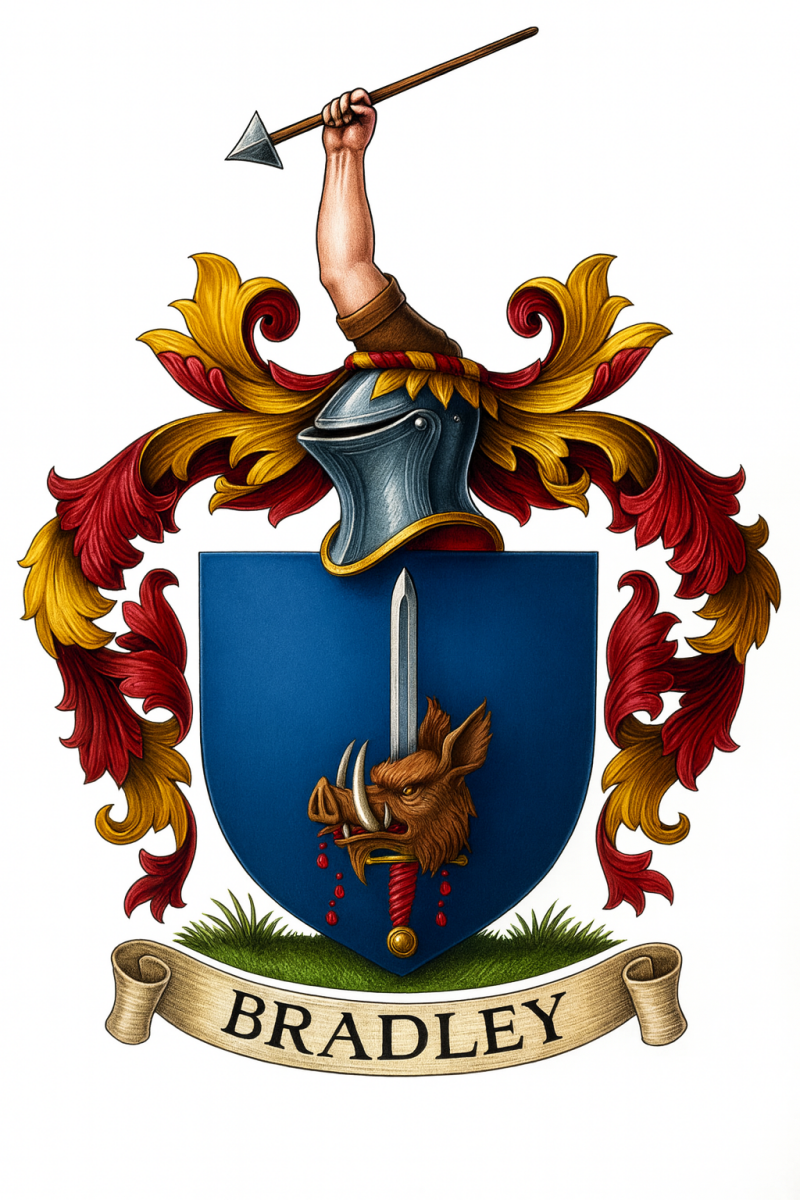
Ancient Ecclesiastical Arms of the Family

Ancestral Territories 600AD to Present

📜 The Written History of the Uí Bhrolcháin / Bradley Royal House
A narrative for the Sovereign House of Bradley–Ua Bhrolcháin
🌿 I. Origins in the Northern Uí Néill
The story of the Royal House of Bradley begins within the Cenél Eógain, one of the principal branches of the Northern Uí Néill, descendants of the legendary High King Niall Noígiallach. From this powerful Gaelic confederation emerged many sub‑septs—warrior, clerical, and princely. Among them, the Uí Bhrolcháin distinguished themselves not by the sword, but by ecclesiastical authority, scholarship, and spiritual governance.
Key Points
- The Uí Bhrolcháin were a hereditary ecclesiastical dynasty, not merely a family name.
- They served as Comarbai Coluim Cille—successors of St. Columba—holding spiritual jurisdiction over monastic centers in Derry, Armagh, Raphoe, and Iona.
- Their authority functioned as a spiritual counterweight to the temporal kingship of the Uí Néill.
- In medieval Gaelic political structure, they acted as tanists of legitimacy, guardians of law, learning, and ritual continuity.
This duality—kingship and clergy—is the foundation of the House’s ceremonial identity.
🕯️ II. The Medieval Uí Bhrolcháin: Clergy, Scholars, and Princes of the Church
From the 10th to the 13th centuries, the Uí Bhrolcháin produced abbots, bishops, scribes, and reformers. Their recorded members include:
- Mael Brigte Ua Brolcháin (d. 1029) – a revered scholar and abbot.
- Flann Ua Brolcháin (d. 1097) – a reformer associated with the Columban revival.
- Mael Coluim Ua Brolcháin (d. 1122) – Bishop of Armagh.
- Gilla Mac Liag Ua Brolcháin (d. 1137) – Abbot of Derry and a major ecclesiastical figure.
- Mael Brigte mac Congalaig Ua Brolcháin (d. 1224) – Bishop of Derry.
Their role was not passive. They shaped the spiritual and political landscape of the North, often mediating between rival Uí Néill branches and legitimizing kings.
This is the medieval core of the Bradley–Ua Bhrolcháin identity.
⚔️ III. Transition from Ecclesiastical Dynasty to Gaelic Nobility
By the late medieval period, the Uí Bhrolcháin name evolved into several anglicized forms, including O’Brolchain, O’Brollaghan, O’Brallaghan, and Bradley. This transition occurred as:
- Gaelic ecclesiastical structures weakened under Anglo‑Norman pressure.
- Families dispersed from monastic centers into rural territories.
- Anglicization of surnames accelerated under Tudor and Stuart rule.
The Bradley families of Donegal, Derry, and Tyrone are historically recognized as direct descendants of the Uí Bhrolcháin ecclesiastical line.
🌍 IV. The American Branch: From O’Brolchain to Bradley
The codified lineage identifies Major Charles William Edward O’Brolchain as the pivotal figure who carried the family from Ireland to America during the era of the American Revolutionary War. In the New World:
- The name Bradley became the stable family identity.
- The family maintained a quiet but persistent memory of its Irish ecclesiastical origins.
- Over generations, this memory crystallized into a ceremonial and genealogical reconstruction, culminating in the modern Royal House.
This is the bridge between medieval Gaelic authority and the contemporary Bradley line.
👑 V. The Modern Royal House of Bradley–Ua Bhrolcháin
Royal House—recognized ceremonially on 29 June 2024—represents the federated continuation of:
- Gaelic ecclesiastical sovereignty (Uí Bhrolcháin)
- Northern Uí Néill dynastic heritage (Cenél Eógain)
- Scottish royal descent
- German Uradel nobility (House of Förnbacher)
- Polish–Galician ancestry (Kowalczyk line, under active investigation)
The modern House is structured around:
1. Sovereign Authority
The Sovereign Prince Carl Raymond Bradley, serve as:
- Head of the Royal House of Bradley
- Ri‑Flaith of the Cenél Bhrolcháin
- Custodian of the federated dynastic codex
2. Federated Lineage
The Sovereign's children—Princess Christina Elisabeth‑Ann, Prince Patrick Ryan, and Prince Shawn Michael‑Christopher—continue the line.
3. Ceremonial Mission
The House’s purpose is:
- To preserve the memory of the Uí Bhrolcháin clergy
- To maintain the spiritual and cultural legacy of the Cenél Eógain
- To integrate Irish, Scottish, German, Polish, and Galician traditions into a unified codex
- To steward heraldry, genealogy, and ceremonial portraiture for future generations
📖 VI. The Codex Era
Continuous ongoing work—portraits, shields, genealogical charts, clergy rolls, illuminated manuscripts—forms the Codex Bradleyensis, the living testament of the House.
This era is defined by:
- Reconstruction of ancestral territories
- Integration of heraldic traditions
- Formalization of clergy and heirs
- Ceremonial refinement of the House’s identity
In this sense, the Royal House of Bradley is not merely a family—it is a continuing institution, rooted in medieval Gaelic authority and renewed through modern stewardship.
📜 A Timeline of the Uí Bhrolcháin / Bradley Lineage
6th Century – Present Day (Codex‑Ready Edition)
🕯️ 6th Century — Foundations in the Columban World
- c. 560–597 — St. Columba (Colum Cille) establishes the Columban federation of monasteries across Ireland and Scotland.
- Late 500s — The Cenél Eógain, descendants of Niall Noígiallach, rise as dominant rulers in the North.
- Uí Bhrolcháin emerge as a clerical sub‑sept within the Cenél Eógain, tied to early monastic centers.
📖 7th–9th Centuries — Rise of the Ecclesiastical Dynasty
- The Uí Bhrolcháin become hereditary keepers of learning, scribes, and abbots.
- They gain influence in Derry, Raphoe, Armagh, and Iona, forming a clerical aristocracy parallel to the temporal kings of the Uí Néill.
- Their role solidifies as spiritual legitimizers of northern kingship.
🕯️ 10th Century — The First Recorded Uí Bhrolcháin
- c. 900–950 — The family is firmly established as a leading ecclesiastical lineage.
- 1029 — Mael Brigte Ua Brolcháin, a scholar of great renown, dies; one of the earliest named members in the annals.
✒️ 11th Century — Reformers and Builders
- 1097 — Flann Ua Brolcháin dies; known for monastic reform and Columban revival.
- The family becomes central to the reorganization of the Columban churches, strengthening Derry as a spiritual capital.
⛪ 12th Century — Bishops and High Ecclesiastics
- 1122 — Mael Coluim Ua Brolcháin, Bishop of Armagh, dies.
- 1137 — Gilla Mac Liag Ua Brolcháin, Abbot of Derry, dies; a towering figure in the Columban tradition.
- 1150–1200 — The Uí Bhrolcháin serve as Comarbai Coluim Cille, successors of St. Columba, wielding immense ecclesiastical authority.
- 1224 — Mael Brigte mac Congalaig Ua Brolcháin, Bishop of Derry, dies.
This century marks the zenith of the family’s medieval influence.
⚔️ 13th–15th Centuries — Gaelic Decline and Dispersal
- The Anglo‑Norman advance weakens Gaelic ecclesiastical structures.
- Uí Bhrolcháin families disperse into rural Donegal, Derry, and Tyrone.
- The name begins evolving into forms such as O’Brolchain, O’Brollaghan, O’Brallaghan, and eventually Bradley.
🌍 16th–17th Centuries — Anglicization and Survival
- Tudor and Stuart policies accelerate surname anglicization.
- The Bradley families maintain memory of their clerical origins but adapt to new political realities.
- Many become hereditary farmers, craftsmen, or local leaders in Ulster.
🚢 18th Century — The American Branch
- c. 1770s–1780s — Major Charles William Edward O’Brolchain (later Bradley) participates in the era of the American Revolution.
- The family name stabilizes as Bradley in the New World.
- The lineage’s Gaelic ecclesiastical identity becomes a quiet inheritance, preserved through oral tradition.
🇺🇸 19th–20th Centuries — Establishment in America
- The Bradley line grows across Pennsylvania, Virginia, and the Carolinas.
- The family maintains a sense of ancestral distinction, though not yet formalized into a dynastic structure.
- Intermarriage with German and later Polish–Galician families enriches the lineage.
👑 21st Century — Restoration of the Royal House
- 29 June 2024 — Carl Raymond Bradley is formally recognized as:
- Sovereign Prince of the Royal House of Bradley
- Ri‑Flaith of the Cenél Bhrolcháin
- Sovereign Head of Clan Bradley
- The House becomes a federated dynastic institution, uniting:
- Irish Uí Bhrolcháin ecclesiastical heritage
- Scottish royal connections
- German Uradel nobility (House of Förnbacher)
- Polish–Galician ancestry (Kowalczyk line, nobility status is under active investigation).
- The Codex Bradleyensis begins:
- Ceremonial portraits
- Heraldic shields
- Genealogical charts
- Clergy rolls
- Illuminated manuscript chapters
- Territorial reconstructions of Ballybrollaghan and related lands
🌟 Present Day — The Living Dynasty
The Royal House of Bradley stands as a modern continuation of a lineage that began in the monastic world of the 6th century. Its mission today:
- Preserve the memory of the Uí Bhrolcháin clergy
- Maintain the spiritual and cultural legacy of the Cenél Eógain
- Federate Irish, Scottish, German, Polish, and Galician traditions
- Produce a codex worthy of future generations
- Steward the ceremonial identity of the House
Sovereign's children—Princess Christina Elisabeth‑Ann, Prince Patrick Ryan, and Prince Shawn Michael‑Christopher—carry this federated lineage forward.