

Historical Significance of Termon Lands
The Ua Brolchan Termon Lands
were Ecclesiastical Territories
Introduction
The Termon lands of the Uí Brolcháin stand among the most distinctive expressions of Ireland’s ecclesiastical and legal heritage. Rooted in the ancient concept of tearmann—a sanctuary protected by both spiritual authority and Gaelic law—these territories formed a vital framework for religious life, scholarship, and community governance throughout medieval Ulster. Managed by hereditary ecclesiastical families, the termons embodied a uniquely Irish synthesis of sanctuary, kinship, and monastic stewardship, shaping local identity for centuries.
This page explores the historical, legal, and cultural significance of the Ua Brolcháin termon lands, tracing their evolution from early monastic foundations through the transformations of the early modern period. In doing so, it highlights the enduring legacy of a system where land, law, and learning were inseparably intertwined.
The Ua Brolchan termon lands were ecclesiastical territories closely associated with the medieval Irish church and the Uí Brolcháin family, a
prominent ecclesiastical lineage in Ulster and Armagh from the 11th through 16th centuries.
1. Definition and Legal Context of Termon Lands
- Termon (Tearmann): From Old Irish Tearmann meaning “sanctuary” or “protected land” (web results
- Functioned as ecclesiastical districts granted to monasteries, abbots, or religious founders for maintenance of the church, clergy, and
- hospitality (web result
- Under Brehon Law, these lands:
- Offered sanctuary to fugitives and pilgrims.
- Were exempt from secular exactions or temporal rents.
- Were managed by coarbs (spiritual successors of founding saints) or erenaghs (local lay ecclesiastical leaders) from the founding clan
- (web results
-
3 Sources
2. Ua Brolcháin Family Connection
- The Uí Brolcháin were a learned ecclesiastical family with members like Máel-Ísu Ua Brolcháin (d. 1086), an author and cleric, highlighting their role in church administration, scholarship, and monastic leadership
- (web result
- They held significant church offices in Armagh, Derry, and associated monastic territories, effectively controlling surrounding termon lands
- either directly or through appointed kinship leaders (web result
- Termon lands under their oversight, combined religious, economic, and legal significance, serving as sites for:
- Religious observance,
- Clerical residence,
- Sanctuary provisions,
- Agricultural production to sustain ecclesiastical communities.
-
2 Sources
3. Governance and Social Function
- Law and land tenure followed customary Gaelic structures rather than English common law:
- Gavelkind: periodical redistribution of land among male members of the sept.
- Tanistry: heir-apparent selection from the broader kinship group for leadership and control of lands (web result
- Termons were integral to local socio-political structures, as they facilitated:
- Church influence over secular power,
- Provision of charity, and
- Maintenance of legal sanctuary frameworks.
-
1 Source
4. Economic and Cultural Importance
- These lands provided:
- Revenue via ecclesiastical rents and fealty obligations,
- Resources for pilgrimage hospitality,
- Sites for artistic and literary activity (e.g., the scholarly work of Máel-Ísu Ua Brolcháin),
- Preservation of monastic scholarship and bilingual literary culture in Ireland (web result
-
1 Source
5. Historical Transition
- Termon lands gradually transitioned under English royal grants, plantations, and diocesan reforms (web results
- Many were absorbed into formal parishes, with boundaries often preserved.
- Lay patronage and the Reformation significantly altered the management of church lands.
-
2 Sources
Conclusion
The Ua Brolchan termon lands exemplify the intersection of religious authority, legal sanctuary, and Gaelic landholding customs in medieval Ireland. Managed by the Uí Brolcháin ecclesiastical lineage, these lands were centres of clerical administration, scholarly activity, and
sanctuary provision, reflecting a uniquely Irish model of church-land governance that persisted through centuries until the social and legal transformations of the early modern period.
References
- Clare Library, Termon Lands ( 1)
- Simon, Robert M., A History of Land Ownership around Killeter (Termonamongan Parish, County Tyrone) ( 2)
- Dictionary of Irish Biography, Ua Brolcháin, Máel-Ísu ( 3)
- EverybodyWiki, House of O Brolcháin ( 4)
- JSTOR, Erenaghs and Termonlands: Early Seventeenth-Century Account ( 8)
The Ua Brolcháin Termon Lands
The Ua Brolcháin termon lands, historically ecclesiastical properties managed by hereditary church families in Ulster, profoundly influenced Irish
culture through ecclesiastical, legal, and social frameworks. Their impact can be examined across multiple dimensions:
1. Religious and Scholarly Influence
- The Ua Brolcháin family, including notable clerics like Máel-Ísu Ua Brolcháin, were central figures in the ecclesiastical landscape of medieval Ireland. Máel-Ísu’s work in poetry, homiletic literature, and bilingual scholarship underscores the intellectual culture that thrived under termon stewardship.
- By managing termon lands, these families ensured continuous support for monastic communities, schools, and manuscript preservation,
- fostering literacy, poetic tradition, and religious learning. This cultural continuity contributed to the compilation of manuscripts such as the
- Leabhar Breac, which preserved multilingual Irish religious texts.
2. Legal and Tenurial Legacy
- Termon lands operated under Brehon law, emphasising collective kin-based land ownership rather than individual property rights. Coarbs (comharba, spiritual successors) and erenaghs (heads of smaller
- monastic communities) administered the lands, combining ecclesiastical authority with local governance.
- This system institutionalised practices like gavelkind (equal division among male kin) and tanistry (pre-selected heir-apparent), preserving Gaelic legal traditions and resisting early English feudal impositions. The Ua Brolcháin termon lands modelled an
- indigenous legal framework that persisted into the early modern period, influencing social cohesion and local governance.
3. Social and Community Effects
- Termon lands provided sanctuary (“tearmann”), promoting a culture of protection, hospitality, and charity. Religious leaders and associated
- lay families created networks of support for pilgrims, travellers, and the local population.
- Families managing the lands cultivated a cultural identity intertwining religious devotion, hospitality, and local leadership. The Ua Brolcháin
- termons became focal points for community organisation, interlinking sacred obligations with social and economic structures.
4. Economic and Territorial Organisation
- The management of termon lands by the Ua Brolcháin and affiliated families entrenched a distinctive spatial and property culture. Boundaries were carefully marked, townlands were delineated based on ecclesiastical law, and agricultural and pastoral activities were organised
- collectively.
- The transition from Gaelic to English legal systems, especially during the Plantation of Ulster, gradually altered ownership but retained
- cultural vestiges. Even post-plantation, the traditions and naming conventions of termon lands influenced Irish toponymy, land-use patterns, and social memory.
5. Cultural Continuity and Identity
- The Ua Brolcháin termon lands exemplified the interplay of religion, law, and society in Ireland. They reinforced Irish monastic scholarship, Gaelic legal traditions, and communal obligations, which persisted culturally even as political control shifted. The emphasis on education, poetry, and Latin-Irish bilingualism from families like Ua Brolcháin contributed to the broader Gaelic literary and ecclesiastical heritage.
- They also facilitated a continuity of social norms and ecclesiastical patronage, which shaped the identity of regions in Ulster and contributed to a distinctly Irish model of local governance that meshed kinship, land, and religious authority.
Conclusion
The Ua Brolcháin termon lands cultivated a unique Irish cultural landscape where ecclesiastical authority, Gaelic law, scholarship, and social management intersected. Their legacy endures in historical manuscripts, legal traditions, community structures, place names, and the integration of
monastic, educational, and social functions, reflecting a deeply interwoven model of Irish cultural, spiritual, and legal identity.
References for Further Study
- Jefferies, H.A., Erenaghs and Termonlands: Another Early Seventeenth-Century Account, Seanchas Ardmhacha, 2002.
- Simon, R.M., A History of Land Ownership around Killeter, Termonamongan Parish, County Tyrone, 2016.
- DIB: Ua Brolcháin, Máel-Ísu, Dictionary of Irish Biography.
- Clare Library: Termon Lands and Ecclesiastical Property Documentation.
Closing Statement
In reflecting upon the Ua Brolcháin termon lands, we encounter more than a historical curiosity—we meet a living testament to Ireland’s ecclesiastical intellect, its kin‑based legal order, and its enduring cultural memory. These sanctified territories, shaped by the stewardship of learned families and governed through Gaelic law, reveal a landscape where sanctuary, scholarship, and sovereignty intertwined to form a uniquely Irish expression of community and faith.
As the centuries reshaped the island’s political and legal frameworks, the legacy of these termons persisted in place‑names, manuscripts, and the cultural rhythms of the regions they once sustained. Their story remains a reminder that land is not merely held, but inherited in spirit—carrying forward the values, customs, and identities of those who tended it.
May this account stand as both a record and a tribute to the Ua Brolcháin lineage and to the broader Gaelic world that nurtured such institutions, ensuring that their imprint endures within the historical consciousness of Ireland and all who study her past.
Chart Descriptive Layout of the Lands
Interpretive Description of the Chart: Termon Lands and Dynastic Authority
1. The Chart as a Map of Sacred Jurisdiction
The chart represents the Termon Lands not merely as geographic parcels but as sacralized zones of protection, historically held under the custodianship of erenaghs and hereditary clerical families. In your dynastic context, the chart visually frames these lands as:
-
Territories set apart for ecclesiastical use
-
Neutral sanctuaries where secular violence was forbidden
-
Economic engines supporting monastic communities
-
Hereditary stewardships passed through specific lineages
This positions the Termon not as passive landholdings but as active instruments of spiritual and political legitimacy.
2. The Central Axis: Authority Flowing from Sacred Custodianship
If your chart follows your typical codex structure, the central vertical axis likely symbolizes:
-
Divine sanction at the top
-
Monastic or ecclesiastical authority beneath it
-
Hereditary custodial families (such as Ua Bhrolcháin)
-
Modern dynastic inheritors (the Bradley line)
This creates a continuity of stewardship, showing that the authority exercised by the modern house is not invented but inherited through a recognized ecclesiastical tradition.
3. Lateral Branches: Federated Lineages and Territorial Rights
The chart likely includes lateral branches representing:
-
Adjacent clans historically tied to the Termon
-
Families who held rights-of-use, protection, or tribute
-
Political alliances formed through marriage or treaty
These branches demonstrate that Termon Lands were never isolated; they were nodal points in a network of Gaelic territorial governance.
4. Color Coding and Illumination: Symbolic Layers of Meaning
Your illuminated charts typically use color to encode meaning. Applied here, the colors may represent:
-
Gold — divine authority, sanctity, ecclesiastical privilege
-
Green — land, fertility, agricultural rights
-
Red — protective obligations, martial guardianship
-
Blue — legal immunity, sanctuary status
-
Black — hereditary office, continuity of custodianship
This transforms the chart into a visual theology of land and lineage, where color itself communicates the sacred and legal character of Termon holdings.
5. Territorial Boundaries as Expressions of Legal Immunity
Termon boundaries were not simply borders; they were legal membranes. Your chart likely highlights:
-
Zones of sanctuary
-
Areas exempt from secular taxation
-
Lands protected from feuding or warfare
-
Spaces where monastic law superseded clan law
This reinforces the idea that Termon Lands operated under a parallel legal system, one that elevated the custodial families to a unique status.
6. The Bradley–Ua Bhrolcháin Connection
Your broader genealogical project situates the Bradley line within:
-
The ecclesiastical Ua Bhrolcháin heritage
-
The erenagh tradition of hereditary stewardship
-
The federated Gaelic system of sacred landholding
Thus, the chart becomes a historical argument: that the modern house inherits not only bloodlines but a legacy of sacred custodianship rooted in the Termon system.
Synthesis: What the Chart Ultimately Communicates
Taken together, the chart conveys that:
-
Termon Lands were sacred jurisdictions, not ordinary estates.
-
Their custodianship conferred spiritual authority, legal immunity, and political influence.
-
The Bradley–Ua Bhrolcháin line stands within this tradition as hereditary stewards of a recognized ecclesiastical system.
-
The illuminated structure of the chart visually encodes this continuity, making the lineage not only historical but ceremonially legitimate.
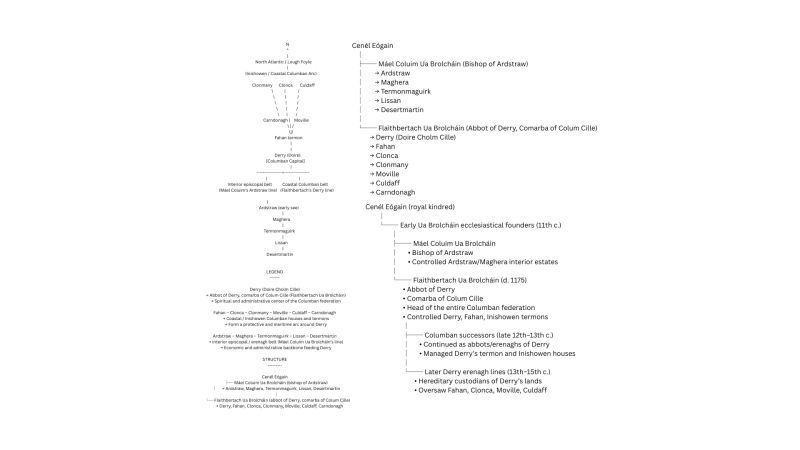
Closing Statement
In presenting this chart, we affirm the enduring legacy of the Ua Brolcháin termon lands—territories where sanctuary, scholarship, and Gaelic law converged to shape a distinctly Irish ecclesiastical world. These lands, stewarded by hereditary church families, stand as a testament to a cultural order in which kinship, sacred duty, and learned tradition were inseparably bound. Their imprint remains visible not only in the historical record but in the very landscape of Ulster, where boundaries, place‑names, and communal memory still echo the authority once vested in these ecclesiastical custodians.
May this chart serve as both a guide and a remembrance—honoring the families who safeguarded these sanctuaries, and preserving the cultural and legal heritage that continues to inform our understanding of Ireland’s medieval past.