

Archive - Treaties
Archival Introduction
Within the Royal House of Bradley–Ó Brócláin, a treaty is recognised as any formal act of friendship, recognition, alliance, or cultural accord entered into under the Sovereign prerogative of His Royal Highness, acting as Fons Honorum et Custos Regalis. These instruments record moments of mutual respect, diplomatic goodwill, and shared purpose between the House and other royal, noble, cultural, or traditional leadership bodies. Each treaty preserved here holds significance not only as a ceremonial bond but as a testament to the House’s ongoing commitment to dignity, heritage, and principled stewardship.
As part of the dynastic codex, these treaties serve as primary archival documents—markers of legitimacy, continuity, and the living relationships that shape the House’s ceremonial role in the modern world. Their inclusion affirms the House’s sovereign right to enter into such accords. It ensures that each agreement is preserved with the same reverence as the heraldic, genealogical, and constitutional records of the dynasty.
Bilateral Treaties of Friendship
Introduction
Bilateral Treaties of Friendship represent the most personal and human-centred expressions of the Royal House of Bradley’s diplomatic character. These accords are entered into by mutual consent between two sovereign or sovereign‑styled Houses, Nations, or Cultural Authorities, each recognising the dignity, heritage, and honourable standing of the other.
Such treaties do not seek political advantage or territorial claim; rather, they affirm respect, goodwill, and the shared pursuit of cultural, humanitarian, and moral stewardship. They are issued under the Sovereign prerogative of His Royal Highness as Fons Honorum et Custos Regalis, and they serve as enduring symbols of peaceful engagement, mutual recognition, and dynastic friendship.
Within this section are the formal instruments that establish these bonds—each one a testament to the House’s commitment to dialogue, intercultural respect, and the strengthening of relations across traditions, continents, and lineages. Every treaty listed here is preserved with its date, parties, purpose, and ceremonial status, ensuring its rightful place within the living codex of the Royal House of Bradley.
Cultural Friendship Accord with the Noble House of Todorovic
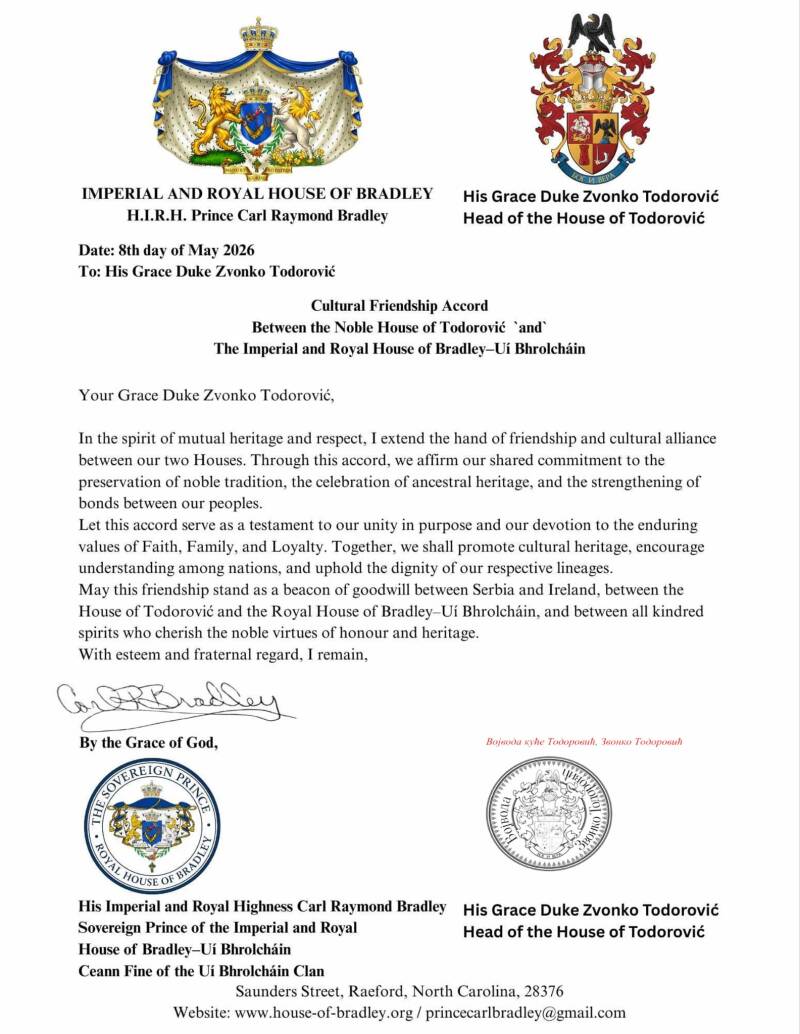
Treaty of Friendship with the Imperial House of Soulouque, Haiti Dynasty

Treaties of Recognition
Introduction
The Treaties of Recognition preserved within this Archive represent the highest form of dynastic acknowledgement extended to the Royal House of Bradley.
These accords are formal instruments through which external sovereigns, traditional monarchs, and princely houses affirm the legitimacy, dignity, and sovereign character of our House. Each treaty stands as a mutual declaration that the parties recognise one another’s historic identity, ceremonial authority, and rightful place within the international community of non‑territorial and traditional sovereignties.
Such treaties carry profound weight: they are not merely diplomatic courtesies, but solemn acts of peer‑to‑peer recognition issued under the prerogatives of reigning or constitutionally acknowledged monarchs, chivalric custodians, or dynastic heads of house. Through these instruments, the Royal House of Bradley is received as an equal in honour, rank, and dignity, and its lineage, traditions, and humanitarian mission are affirmed before the wider world.
Within this section, each Treaty of Recognition is presented with its date, parties, ceremonial status, and archival metadata, ensuring that every accord is preserved with the clarity and permanence befitting its sovereign character.
Treaty of Recognition
GBI HOHOE AHADO

Treaty of Recognition with the
Imperial House of Soulouque, Haiti Dynasty

Dynastic or Heraldic Alliances
Introduction
Within the annals of the House of Bradley, the forging of dynastic and heraldic alliances stands as one of the most enduring instruments of sovereignty, diplomacy, and cultural stewardship. These alliances—formalised through treaties of friendship, mutual recognition, and ceremonial kinship—bind the Princely House of Bradley–Ó Brólcháin to a wider constellation of royal, imperial, and indigenous nations. Each pact reflects not merely political accord, but a shared commitment to legitimacy, continuity, and the preservation of ancestral dignity.
Across centuries, such alliances have served as bridges between traditions: linking European noble houses with Caribbean imperial legacies, uniting Gaelic custodianship with Native American sovereignty, and affirming the House’s role as a federating steward among diverse lineages. The treaties preserved in this archive represent the living architecture of that federation—documents through which honour is exchanged, titles recognised, and heraldic symbols woven into a broader tapestry of kinship.
This section presents those alliances in their ceremonial order, offering context on their origins, heraldic significance, and place within the evolving diplomatic landscape of the Bradley–Ó Brólcháin Federation.
Intercultural or Indigenous Nation Treaties
Intercultural or Indigenous Nation Treaties — Introduction
Intercultural or Indigenous Nation Treaties embody the Royal House of Bradley–Ó Brólcáin’s commitment to honouring the ancient sovereignties, living traditions, and enduring identities of the world’s First Peoples. These accords are entered into with Nations, Tribes, Clans, and Cultural Authorities whose legitimacy is rooted not in modern statehood, but in ancestral continuity, communal memory, and sacred custodianship of land and heritage.
Such treaties affirm mutual respect, cultural recognition, and the dignity of Indigenous self‑definition. They acknowledge that sovereignty may be expressed through lineage, ceremony, and tradition just as surely as through political institutions. Each treaty in this section reflects a bond formed in good faith—one that honours the wisdom of elders, the sanctity of heritage, and the shared pursuit of peace, humanity, and cultural preservation.
As part of the dynastic codex, these instruments stand as bridges between worlds: between royal and tribal, ancestral and contemporary, ceremonial and living.
They testify to the House’s dedication to intercultural diplomacy, ethical stewardship, and the respectful joining of hands across traditions, histories, and peoples.
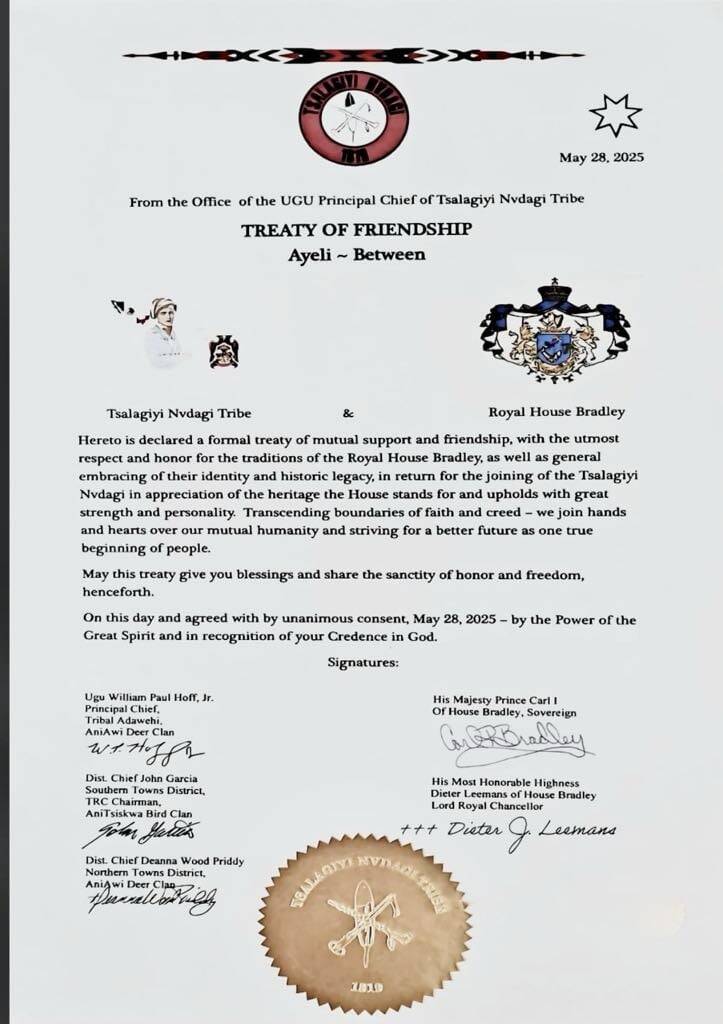
Treaty of Recognition with The Cherokee Nation
Historic or Legacy Agreements
Introduction
The Historic or Legacy Agreements preserved within this archive represent the earliest foundations upon which the modern diplomatic character of the Royal House of Bradley was shaped. Though many of these accords originate from prior generations, earlier custodial eras, or predecessor branches of the wider Bradley–Ó Brólcáin lineage, each stands as a testament to the enduring human impulse toward fellowship, mutual respect, and shared purpose across communities and cultures.
These agreements—some ceremonial, some practical, some symbolic—form a living bridge between past and present. They illuminate the values that guided earlier custodians of the House, reveal the relationships that influenced its development, and provide essential historical context for the evolution of its sovereign traditions.
By preserving these legacy documents within the codex, the House affirms not only their historical significance but also the continuity of honour, duty, and goodwill that threads through its lineage. They remain touchstones of identity, memory, and dynastic heritage, offering insight into the long arc of relationships that helped shape the House’s standing in the world today.
Closing Statement
The treaties preserved within this Archive stand as enduring witnesses to the diplomatic character of the Royal House of Bradley. Each accord—whether of friendship, recognition, or mutual respect—reflects the House’s commitment to principled alliance, cultural honour, and the continuity of sovereign relations across nations and dynasties. May these records remain a testament to the House’s steadfast pursuit of peace, legitimacy, and honourable engagement with all who extend their hand in goodwill.