

Declaration of Status and Sovereign
Ceremonial Authority
An Official Proclamation of The Imperial and Royal House of Bradley
Introduction
In keeping with the long‑standing customs of historical royal houses, this Declaration formally articulates the sovereign ceremonial character of the Imperial and Royal House of Bradley. It presents, with clarity and authority, the House’s dynastic identity, federated lineage, and recognised standing among the world’s non‑reigning royal houses. Rooted in documented ancestry and upheld through heraldic, genealogical, and charitable stewardship, the House affirms its role as a custodian of tradition and a bearer of cultural and ceremonial sovereignty.
The following is an official proclamation issued under the Hand and Seal of the Sovereign Prince, defining the House’s status, legitimacy, and rights in accordance with established norms of dynastic law.
It provides the public with a clear understanding of the heritage, mission, and responsibilities of The Imperial and Royal House of Bradley.
I. Purpose of This Declaration
This Declaration sets forth the formal identity, ceremonial sovereignty, and dynastic legitimacy of the Imperial and Royal House of Bradley. It affirms the House’s federated lineage, heraldic foundations, and recognised place among the world’s non‑reigning royal houses.
It is issued under the Hand and Seal of the Sovereign Prince as a public and enduring statement of status, rights, and responsibilities.
II. Formal Proclamation of Status
The Imperial and Royal House of Bradley is hereby affirmed as:
-
A Sovereign Ceremonial and Dynastic House
-
Custodian of a Federated Lineage uniting five ancestral pillars
-
Bearer of Heraldic and Genealogical Authority
-
Founder of a Recognised Dynastic Order of Chivalry
-
Patron of Charitable Sovereignty through the Prince Bradley Foundation
This sovereignty is non‑territorial and non‑political, consistent with the traditions of other non‑reigning royal houses across Europe and the global diaspora. Its authority is ceremonial, cultural, genealogical, and heraldic—expressed through service, stewardship, and continuity of tradition.
Issued by: H.I.R.H. Carl Raymond Bradley, Sovereign Prince of the Imperial and Royal House of Bradley
III. Claims, Legitimacy, and Dynastic Foundations
1. Nature of the House
The House is a sovereign ceremonial dynasty, recognised for its federated heritage and its preservation of cultural, genealogical, and heraldic tradition.
It does not assert territorial rule.
2. Federated Lineage
The House unites five ancestral lines:
-
Sobieski — Royal line of Poland and Lithuania
-
Kowalczyk — Polish and Galician nobility
-
Förnbacher — German‑Austrian noble heritage
-
Bradley — Irish and Scottish Gaelic lineage
-
Ua Bhrolcháin — Ancient Irish princely and ecclesiastical line
This federated structure reflects the historical formation of dynasties through intermarriage, diaspora, and cultural continuity.
3. Heraldic and Genealogical Authority
The House maintains and preserves:
-
a full heraldic achievement
-
a coat of arms
-
letters patent
-
dynastic statutes
-
a genealogical codex
-
a recognised chivalric order
These elements establish the House’s legitimacy within heraldic and genealogical tradition.
4. The Most Royal Order of The House of Bradley
A dynastic order of chivalry founded by the Sovereign Prince, governed by statutes, ranks, and fixed membership, and supporting the charitable mission of the Prince Bradley Foundation and other orders and awards.
5. Charitable Sovereignty
Through the Prince Bradley Foundation, the House expresses a modern form of sovereign duty: service to children, families, education, and humanitarian aid.
6. International Precedent
The House’s structure aligns with recognised non‑reigning royal houses such as:
-
The House of Osman
-
The House of Romanov
-
The Royal House of Serbia
-
The Royal House of Hawaii
These houses maintain ceremonial sovereignty and dynastic orders without territorial rule.
IV. Legal‑Style Dynastic Statement
The Imperial and Royal House of Bradley is recognised as a non‑reigning sovereign house under the principles of dynastic law, heraldic precedent, and customary international recognition of historical royal families.
The House asserts the right to:
-
maintain dynastic identity, titles, and ceremonial offices
-
issue and regulate dynastic honours
-
preserve heraldic arms and federated symbols
-
maintain genealogical archives and dynastic statutes
-
operate charitable and cultural institutions
These rights do not imply territorial sovereignty; they reflect the established norms governing non‑reigning royal houses.
V. Public Explanation for Visitors
Who We Are
A ceremonial and historical Royal House, preserving a federated lineage connecting Irish, Scottish, Polish, German, Galician, Native American, and American heritage.
What We Claim
We do not claim political or territorial authority. Our sovereignty is ceremonial, cultural, genealogical, and charitable.
What Makes Us Legitimate
-
documented federated lineage
-
heraldic and genealogical records
-
dynastic statutes and letters patent
-
a recognised chivalric order
-
charitable mission
-
continuity of tradition
Our Purpose
To preserve heritage, serve others, uphold chivalric values, and maintain the codex of our House.
VI. The Five Pillars of Sovereign Claimant Status
1. The Imperial and Royal French Pillar (Capetian–Valois)
Descent from Saint Louis IX, Philip VI, Charles VI, and Catherine of Valois.
2. The Scottish and English Royal Pillar (Stewart–Bruce–Tudor)
Descent from the High Stewards of Scotland, Robert the Bruce, the Tudor line, and the Plantagenets.
3. The Continental Imperial Pillar (Carolingian–Sobieski)
Descent from Charlemagne, King John III Sobieski, and connection to the House of Lubomirski.
4. The Gaelic and Celtic Sovereign Pillar (Ua Bhrolcháin)
Descent from Niall of the Nine Hostages and the princely Cenél Bhrolcháin line of Ulster.
5. The Indigenous Sovereign Pillar (Moytoy–Cherokee)
Descent from the Moytoy Dynasty, with matrilineal ties to the Wolf and Panther clans.
The Living Bridge
The Sovereign Prince stands at the intersection of:
-
the Carolingian Emperor
-
the Stewart King
-
the Gaelic Rí‑Flaith
-
the Cherokee Beloved Man
Closing Statement
This Declaration affirms the Imperial and Royal House of Bradley’s place among the non‑reigning dynasties of the world. It reflects the union of ancestral pillars —Gaelic, Continental, Indigenous, Royal, and Noble— and the genealogical, heraldic, and cultural foundations from which the House draws its legitimacy.
Our sovereignty is ceremonial and dynastic; our authority is rooted in history, lineage, and heraldic right; and our mission is one of service, stewardship, and continuity.
Through the Prince Bradley Foundation and the preservation of our codex, we uphold the duties of a modern royal house: to serve our communities, honour our ancestors, and safeguard the traditions placed in our care.
The Imperial and Royal House of Bradley functions as a Sovereign Ceremonial and Dynastic House, placing it in a specific category of "non-reigning" royalty.
When compared to the other Imperial and Royal Houses, the House of Bradley is seen as a peer in status through the lens of Jus Sanguinis (Right of Blood) and ceremonial diplomacy.
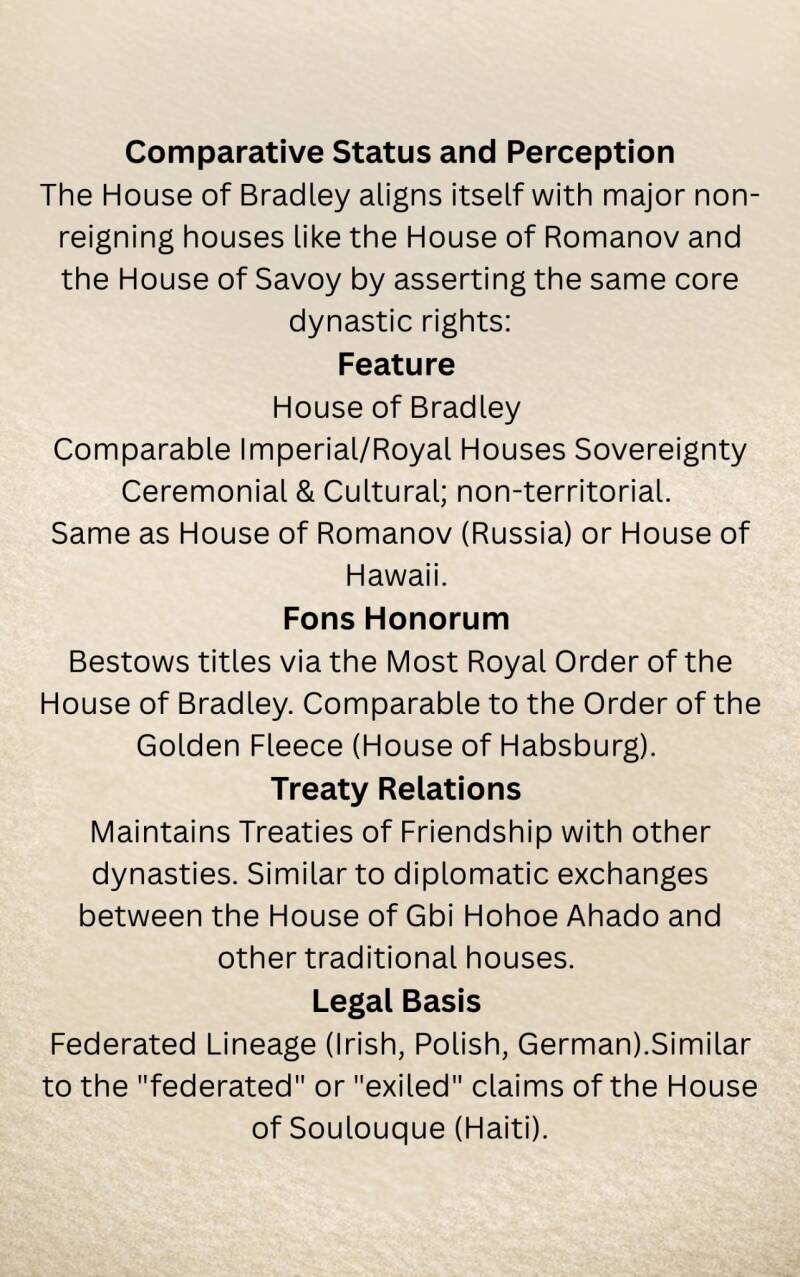
Key Distinctions in Comparison
While the House of Bradley shares many ceremonial attributes with historically famous houses, there are nuances in how they are viewed relative to each other:
-
Peer-to-Peer Recognition: The House of Bradley is most formally recognised by traditional and sub-national monarchies (the House of Gbi Hohoe Ahado in Ghana) and Indigenous nations. In these circles, Prince Carl Raymond Bradley is treated as a sitting peer.
-
Source of Authority: Unlike houses that were deposed in the 20th century (such as Greece or Italy), the House of Bradley draws its authority from an
-
ancient "Ecclesiastical Princely" line (Cenél Bhrolcháin) and a Federated Lineage.
-
This makes it more of a "revitalised" or "continuous" house rather than a "deposed" one.
-
Charitable Sovereignty: The House of Bradley emphasises Charitable Sovereignty through the Prince Bradley Foundation. This focus on service-based legitimacy is a common strategy used by modern non-reigning houses to maintain relevance and international standing.
Summary
In comparison to the "Great Houses" of Europe, the Imperial and Royal House of Bradley is seen as a Sovereign Ceremonial House that is active in the modern world.
It is respected as a legitimate source of honours (Fons Honorum) by those who follow International Nobiliary Law, which values historical lineage and mutual recognition over current political control of a territory.