LINE OF SUCCESSION
House of Bradley – Revised Succession Charter (20th May 2026)
Primogeniture: Core Definition
Primogeniture is the legal or customary principle in which the firstborn legitimate child inherits the parents’ primary estate. Historically, this meant the eldest son inherited everything, excluding daughters, illegitimate children, and collateral relatives.
Historical Variations
Across Europe, several forms of primogeniture developed:
-
Male-line primogeniture — inheritance passed strictly through the eldest male descendant.
-
Male-preference primogeniture — daughters could inherit only if no sons existed.
-
Salic and semi‑Salic systems — excluded women entirely or limited their rights.
-
Post–World War II reforms — many monarchies removed male preference, adopting gender‑equal succession.
Countries such as Belgium, Denmark, Luxembourg, the Netherlands, Norway, Sweden, and the United Kingdom now follow absolute primogeniture.
Primogeniture in Noble Titles
Within noble houses, primogeniture traditionally ensured estates remained intact:
-
The eldest son’s line inherited first (“right of substitution”).
-
Daughters could receive life use of property, while substantive inheritance passed to their senior male descendants.
-
If no children survived, inheritance moved to the eldest brother and his line.
This system preserved estates but often disinherited female relatives unless no male heirs existed.
Updated Succession Law of the House of Bradley
The Imperial and Royal House of Bradley has modernised its succession principles:
-
The firstborn child inherits, regardless of gender.
-
If the heir is female, the lineage remains within the House of Bradley; her consort holds no claim to authority.
-
The sovereign may, by letters patent, designate any child as heir, selecting the one best suited to rule.
-
The Head of House will always remain a member of the House of Bradley, including cadet branches.
HRH Princess Christina Elisabeth‑Ann Bradley, firstborn daughter of HRH Prince Carl, is the designated successor.
👑 THE IMPERIAL‑ROYAL HOUSE OF BRADLEY–UÍ BHROLCHÁIN
Complete Lineage and Order of Precedence
(With Paternal First Cousins Integrated - Dated: 20th May 2026)
I. SOVEREIGN LINE
H.I.R.H. Carl Raymond Bradley Sovereign Prince of the Imperial‑Royal House of Bradley–Uí Bhrolcháin
H.I.R.H. Princess Consort Elke Petra Scherlein Imperial‑Royal Princess Consort
II. ROYAL CHILDREN AND GRANDCHILDREN
H.I.R.H. Princess Christina Elisabeth‑Ann Bradley
Princess of the Blood Imperial
-
H.R.G. Earl, Brayden Albert Rettburg
H.I.R.H. Prince Patrick Ryan Bradley
Prince of the Blood Imperial
-
H.R.G. Baroness, Skylar Bradley
-
H.R.G. Baroness, Harper Bradley
-
H.R.G. Baroness, Bailey Bradley
H.I.R.H. Prince Shawn Michael‑Christopher Bradley
Prince of the Blood Imperial
-
H.R.G. Baron, Mason Gabriel Bradley
-
H.R.G. Baroness, Sophia Michelle Bradley
III. COLLATERAL LINE (Sovereign’s Siblings)
H.R.H. Princess Royal Kathleen Marie Bradley
H.S.H. Princess Mary Esther Bradley
H.S.H. Princess Barbara Ann Bradley
H.S.H. Princess Denise Lynn Bradley
IV. ISSUE OF THE SOVEREIGN’S SIBLINGS
Children of Princess Royal Kathleen Marie Bradley
-
Lord William Albright
-
Lady Sarah Albright
Children of Princess Mary Esther Bradley
First Marriage (Singer Line)
-
Lord Mark Singer Jr.
-
Lord Matthew Singer
Second Marriage (Hollern Line)
-
Lady Shannon Hollern
-
Lady Morgan Hollern
Children of Princess Barbara Ann Bradley
First Marriage
-
Lady Stephanie Stacey‑Patterson
Second Marriage
-
Lady Joyce Hughes‑Coleman
Child of Princess Denise Lynn Bradley
-
Lady Theresa Althea Bowman
——— ALL STEP‑ROYAL LINES BEGIN HERE———
Your Imperial‑Royal Highness has decreed that all Step‑Royal categories follow after the collateral line. This is now the official and final structure.
V. STEP‑ROYAL ISSUE OF THE PRINCESS CONSORT
(Children of her first marriage — courtesy styled as decreed by the Sovereign)
-
Mrs. Alexandra Scherlein–Haskic–Kidd
-
Mr. Marco Andreas Haskic
-
Mr. Ronny Haskic
VI. STEP‑ROYAL DESCENDANTS OF THE PRINCESS CONSORT’S LINE
(Children of Alexandra and Ronny — ordered by birth)
-
Master Dominick Seth Haskic‑Kidd — Adopted
-
Mrs. Madaline Kidd — Consort of Dominick
-
Mr. Nathanial Kidd
-
Miss Hailey Haskic
VII. STEP‑ROYAL ISSUE OF PRINCESS CHRISTINA’S CONSORT
-
Master Avinn Michael Horton
VIII. EXTENDED COLLATERAL LINE — PATERNAL FIRST COUSINS
(Noble Companion Class of the House)
High Nobility of the House
-
H.G. Viscountess Thelma Jean Bradley
-
H.G. Baron of the House, Michael Bradley
-
H.G. Baron of the House, Jeffrey Bradley
-
H.G. Baron of the House, David Thiess
Knight‑Companions of the House
-
Sir Collin P. Bradley
-
Sir Keith A. Bradley
-
Sir James M. Bradley
-
Sir Brian Bradley
-
Sir Shawn Bradley
-
Sir Timothy Casillo
-
Sir William R. Bates
-
Sir James F. Bates
-
Sir Joseph Bates
Dames of the House
-
Dame Terrie Bradley
-
Dame Sherry L. Bradley‑Zylak
-
Dame Kathleen Ardry‑Ogletree
✠ THE FINAL CADET BRANCH REGISTER ✠
Of the Imperial & Royal House of Bradley–Uí Bhrolcháin
Established and Confirmed Under His Imperial & Royal Highness, The Sovereign Prince Carl Bradley
This Register records all Recognised Cadet Branches, their founders, current heads, territorial designations, and rank within the dynastic hierarchy.
I. THE PREMIER CADET BRANCH
(Highest-ranking branch descending from the Sovereign’s siblings)
1. The Altoona Bradley’s
Style: The Earl’s House of Altoona Rank: Premier Cadet Branch (Earl) Founder: H.R.H. Kathleen, The Princess Royal, through her eldest surviving son, HRG William Albright
Current Head: HRG William Albright, 1st Earl of the House
Status: Recognised Cadet Branch
Notes:
-
The senior cadet branch of the Royal House.
-
The only branch descending directly from the Princess Royal.
-
Holds precedence over all other cadet houses.
II. THE NOBLE CADET BRANCHES
(Cadet houses elevated to noble rank)
2. The Colorado Bradley’s
Style: The Earl’s House of Colorado Rank: Noble Cadet Branch (Earl) Founder: The eldest brother of Gerald Paul Bradley, through his son,
Current Head: HG Earl Brian Bradley
Status: Recognised Cadet Branch
Notes:
-
A senior collateral line of the Bradley patriarchal generation.
-
Second in precedence among noble cadet houses.
-
Represents the western expansion of the Bradley lineage.
III. THE VISCOUNTAL CADET BRANCH
(A cadet house of mid‑noble dignity)
3. The Williamsport Bradley’s
Style: The Viscountal House of Williamsport Rank: Viscountal Cadet Branch Founder: Thomas Bradley, the next‑older brother of Gerald Paul Bradley, through his eldest surviving child,
Current Head: HG Viscountess Thelma Jean Bradley
Status: Recognised Cadet Branch
Notes:
-
The senior sibling cadet branch of your father’s generation.
-
The oldest geographically distinct cadet house.
-
Holds precedence below the Earls but above all gentry branches.
IV. THE GENTRY CADET BRANCH
(A cadet house of gentle but non‑noble rank)
4. The Meadville Bradley’s
Style: The Gentle House of Meadville Rank: Gentry Cadet Branch Founder: The eldest sister of HG Earl Brian Bradley, establishing a junior sibling cadet line in Meadville.
Current Head: Dame Sherry L. Bradley‑Zylak
Status: Recognised Cadet Branch
Notes:
-
The junior sibling branch of the Colorado Earl’s House.
-
Lowest-ranking recognised cadet house, but still of the Blood Royal.
-
Represents the gentry‑level extension of the Bradley lineage.
✠ ORDER OF PRECEDENCE OF THE CADET BRANCHES ✠
From highest to lowest
-
House of Altoona — Premier Earl (Princess Royal’s line)
-
House of Colorado — Earl (eldest brother’s line)
-
House of Williamsport — Viscount (next‑older brother’s line)
-
House of Meadville — Gentry (junior sibling line)
THE ROYAL MARRIAGES ACT
of the Imperial and Royal House of Bradley–Ua Bhrolcháin
Enacted by the Sovereign Prince and Fons Honorum
PREAMBLE
By the Sovereign Authority vested in H.I.&R.H. Carl Raymond David Bradley, Sovereign Prince (Rí‑Flaith) of the Imperial and Royal House of Bradley–Ua Bhrolcháin, Prince of the Blood Imperial and Royal, Fons Honorum of the House, Guardian of the Dynastic Lineage, and Keeper of the Codex, this Act is promulgated to regulate the marriages of all persons belonging to the Imperial and Royal House, to safeguard the purity of lineage, the dignity of titles, and the continuity of the Sovereign Blood.
I. SCOPE OF THE ACT
This Act applies to:
-
The Sovereign Prince
-
The Heir Apparent / Heir Presumptive
-
All Princes and Princesses of the Blood Imperial
-
All Princes and Princesses of the Blood Royal
-
All members of the Dynastic Line within three generations of a Sovereign
-
Any person who holds, or may inherit, a title of the Imperial & Royal House of Bradley
No marriage contracted by any of the above is valid for dynastic purposes unless it conforms to this Act.
II. REQUIREMENT OF SOVEREIGN CONSENT
Article 1 — Necessity of Consent
No member of the Imperial and Royal House may contract marriage without the explicit written consent of the Sovereign Prince.
Article 2 — Form of Consent
Consent must be:
• Issued under the Great Seal of the House • Entered into the Master Codex of Titles and Lineage • Witnessed by the Royal Chancellor and the Keeper of the Codex
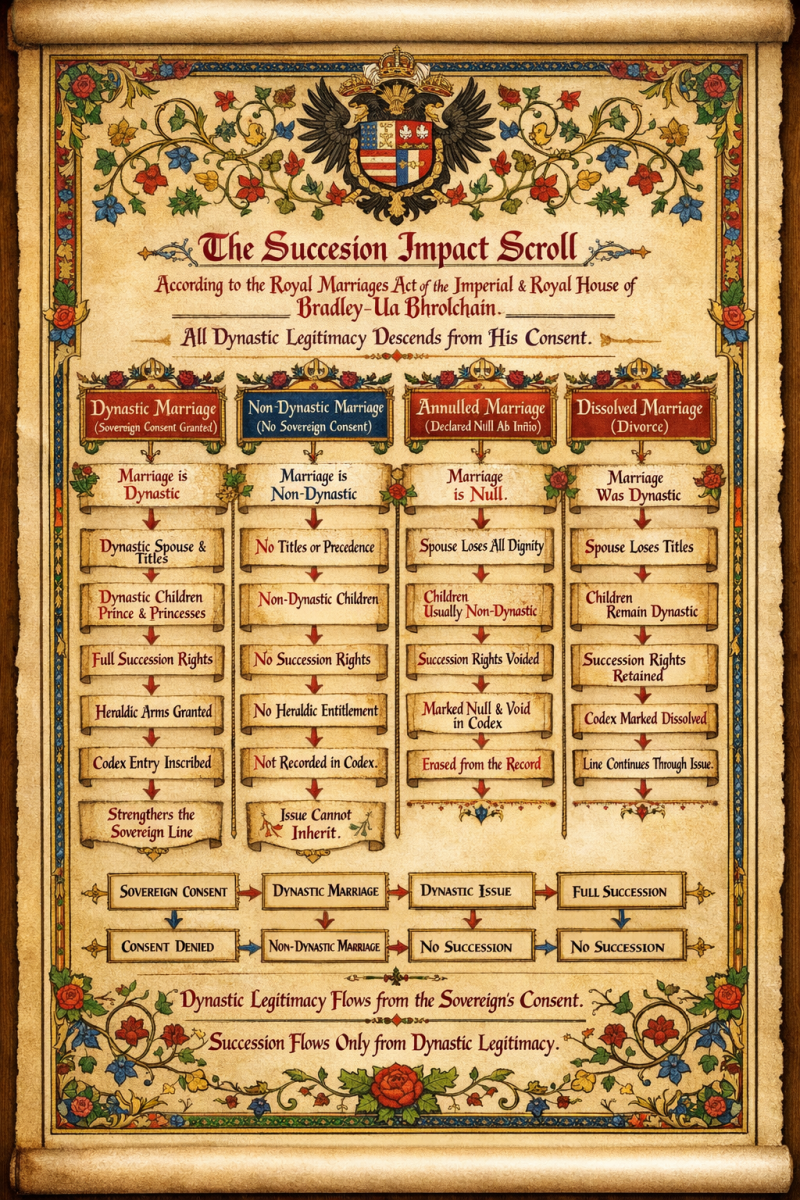
Article 3 — Effect of Marriage Without Consent
A marriage contracted without Sovereign Consent:
• Is non‑dynastic • Confers no titles, styles, or precedence upon the spouse • Produces no dynastic issue eligible for succession or titles • May result in the loss or suspension of the offender’s own dynastic rights
III. ELIGIBILITY OF SPOUSES
Article 4 — Requirements for a Dynastic Marriage
A spouse must be:
-
Of good character and reputation
-
Of sound mind and free will
-
Of legal age
-
Not bound by any prior marriage
-
Willing to uphold the dignity, customs, and ceremonial obligations of the House
Article 5 — Noble or Royal Birth
While noble or royal birth is preferred, it is not required. However, the Sovereign Prince may elevate a spouse to an appropriate rank by:
• Letters Patent • Dynastic Decree • Grant of Courtesy Title
IV. EFFECTS OF MARRIAGE ON TITLES
Article 6 — Titles of the Consort
A spouse of a dynastic member shall receive:
• The courtesy style appropriate to the rank of the husband or wife • No right to arms, precedence, or titles except by Sovereign Grant
Article 7 — Titles of Issue
Children born of a dynastic marriage:
• Are Princes or Princesses of the Blood Imperial or Royal according to their parents’ rank • Are entered into the Line of Succession • Bear the Arms of the House of Bradley–Ua Bhrolcháin with appropriate cadency
Children born of a non‑dynastic marriage:
• Are not Princes or Princesses • Hold no dynastic rights • May be granted courtesy titles only by Sovereign Decree
V. RELIGIOUS AND CEREMONIAL REQUIREMENTS
Article 8 — Form of Marriage
A dynastic marriage must be:
• Celebrated in a recognised religious or civil rite • Registered in the Master Codex • Witnessed by at least one Officer of the Court (Royal Chancellor, Royal Chamberlain, or Herald of Arms)
Article 9 — Conversion or Religious Obligation
No spouse is required to convert to another religion. However, the Sovereign may require:
• A pledge to raise children within the traditions of the House • Respect for the House’s ceremonial and ancestral customs
VI. ANNULMENT AND DISSOLUTION
Article 10 — Annulment
A marriage may be annulled if:
• Consent was obtained by fraud or coercion • One party concealed a prior marriage • The marriage was not consummated • The marriage violates this Act
Article 11 — Divorce
Divorce does not automatically remove dynastic rights, but:
• The Sovereign may issue a Decree of Separation from Dynastic Status • Titles granted by marriage may be revoked • Issue born before the divorce remain dynastic
VII. SPECIAL PROVISIONS FOR THE SOVEREIGN PRINCE
Article 12 — Marriage of the Sovereign
The marriage of the Sovereign Prince:
• Must be approved by the Council of the Crown • Must be proclaimed publicly • Elevates the spouse to Princess Consort or Prince Consort • Is entered into the Codex with full ceremonial honors
VIII. ENFORCEMENT AND INTERPRETATION
Article 13 — Authority
Interpretation of this Act rests solely with:
• The Sovereign Prince • The Keeper of the Codex • The Royal Chancellor
Article 14 — Amendments
No amendment is valid unless:
• Proposed by the Sovereign • Attested by the Keeper of the Codex • Entered into the Master Codex
IX. FINAL CLAUSE
This Act supersedes all prior customs, decrees, or traditions relating to marriage within the Imperial & Royal House of Bradley–Ua Bhrolcháin.
It enters into force upon its inscription into the Master Codex of Titles and Lineage.
👑 STATUTE ON THE LAWFUL REMOVAL FROM THE ORDER OF PRECEDENCE
Enacted by the Sovereign Prince of the Royal House of Bradley–Uí Bhrolcháin
Article I — Authority of the Sovereign
-
The Sovereign Prince holds the exclusive and inherent right to determine, amend, or rescind the Order of Precedence of the Royal House.
-
This authority derives from the Sovereign’s role as Fons Honorum, guardian of dynastic integrity, and custodian of the Codex.
-
No removal shall be lawful unless enacted by formal decree issued under the Sovereign’s hand and seal.
Article II — Grounds for Lawful Removal
A member of the Royal House may be removed from the Order of Precedence only upon one or more of the following grounds:
-
Renunciation — voluntary withdrawal from dynastic duties or identity.
-
Conduct Unbecoming — actions that bring disrepute upon the House.
-
Marriage Without Sovereign Consent — where such consent is required by statute.
-
Apostasy or Ideological Departure — abandonment of the cultural, ceremonial, or ancestral obligations of the House.
-
Persistent Dereliction of Duty — refusal to uphold obligations assigned by the Sovereign.
-
Request of the Individual — where the member petitions for removal.
No other grounds shall be considered lawful.
Article III — Forms of Removal
Upon lawful cause, the Sovereign may reassign the individual to one of the following statuses:
1. Placed Out of Precedence
The individual remains a dynast but holds no ceremonial rank.
2. Declared Non‑Dynastic
The individual remains a blood relative but is removed from the dynastic body, succession, and precedence.
3. Assigned to the House of Courtesy
The individual retains courtesy recognition but no rights of precedence.
4. Struck from the Rolls
The individual is removed entirely from the Royal House and expunged from the Codex.
Each category is lawful, but the Sovereign shall choose the one proportionate to the cause.
Article IV — Procedure of Removal
-
The Sovereign shall issue a Decree of Removal, naming:
-
The individual concerned
-
The grounds invoked
-
The new status assigned
-
The effective date
-
-
The decree shall be entered into the Codex of the Royal House.
-
The individual shall be notified in writing unless the Sovereign determines otherwise for reasons of dignity or security.
-
The decree takes effect immediately upon issuance.
Article V — Consequences of Removal
Depending on the status assigned:
-
Placed Out of Precedence — loses ceremonial rank but remains a dynast.
-
Declared Non‑Dynastic — loses all dynastic rights, titles, and succession standing.
-
House of Courtesy — retains name and recognition but no authority or precedence.
-
Struck from the Rolls — loses all connection to the House, its titles, and its history.
No removed individual may claim precedence, titles, or privileges unless restored by the Sovereign.
Article VI — Restoration
-
Only the Sovereign may restore a removed individual.
-
Restoration must be enacted by formal decree.
-
Restoration may be full or partial, at the Sovereign’s discretion.
Article VII — Final Authority
All questions of interpretation, application, or dispute arising from this Statute shall be resolved solely by the Sovereign Prince, whose judgment is final and binding.
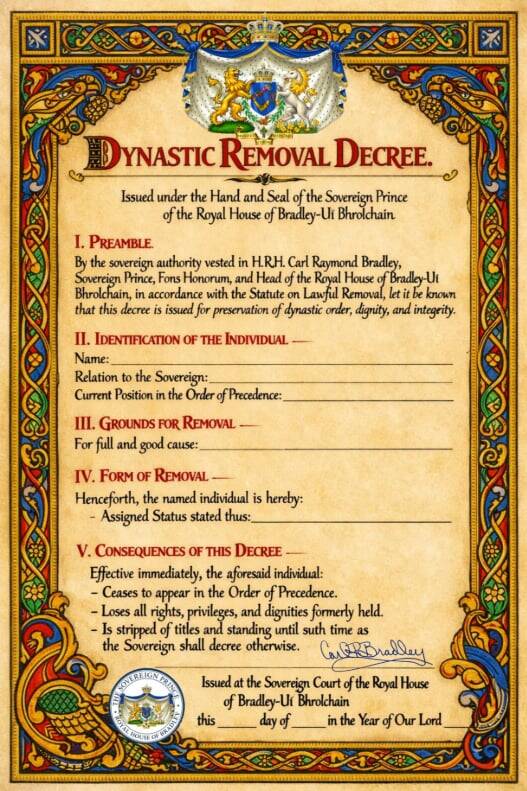
👑 DYNASTIC REMOVAL DECREE
Issued under the Hand and Seal of the Sovereign Prince of the Royal House of Bradley–Uí Bhrolcháin
I. Preamble
By the sovereign authority vested in H.R.H. Carl Raymond Bradley, Sovereign Prince, Fons Honorum, and Head of the Royal House of Bradley–Uí Bhrolcháin, and in accordance with the Statute on Lawful Removal, let it be known that this decree is issued for the preservation of dynastic order, dignity, and integrity.
II. Identification of the Individual
Name: __________________________________________ Relation to the Sovereign: __________________________________________ Current Position in the Order of Precedence: __________________________________________
III. Grounds for Removal
The Sovereign, having considered the matter fully and justly, finds lawful cause under:
-
Renunciation
-
Conduct Unbecoming
-
Marriage Without Sovereign Consent
-
Apostasy or Ideological Departure
-
Persistent Dereliction of Duty
-
Petition of the Individual
(Circle or specify the applicable ground.)
IV. Form of Removal
By sovereign judgment, the individual named above is hereby reassigned to the following lawful status:
1. Placed Out of Precedence
— Retains dynastic identity but holds no ceremonial rank.
2. Declared Non‑Dynastic
— Remains a blood relative but is removed from the dynastic body, succession, and precedence.
3. Assigned to the House of Courtesy
— Retains name and courtesy recognition but no dynastic rights.
4. Struck from the Rolls
— Removed entirely from the Royal House and expunged from the Codex.
(Circle or specify the assigned status.)
V. Consequences of This Decree
Effective immediately upon issuance:
-
The individual shall cease to appear in the Order of Precedence.
-
The individual shall lose all rights, privileges, and dignities associated with their former rank.
-
The individual shall not claim precedence, titles, or ceremonial standing unless restored by the Sovereign.
-
The decree shall be entered into the Codex of the Royal House as a permanent record.
VI. Sovereign Signature and Seal
Issued at the Sovereign Court of the Royal House of Bradley–Uí Bhrolcháin on this ______ day of __________________, in the Year of Our Lord ________.
______________________________ H.R.H. Carl Raymond Bradley Sovereign Prince of Bradley–Uí Bhrolcháin
(Affix Seal Here)