

✦ Dynastic Tree of the Uí Bhrolcháin ✦
✦ Introduction ✦
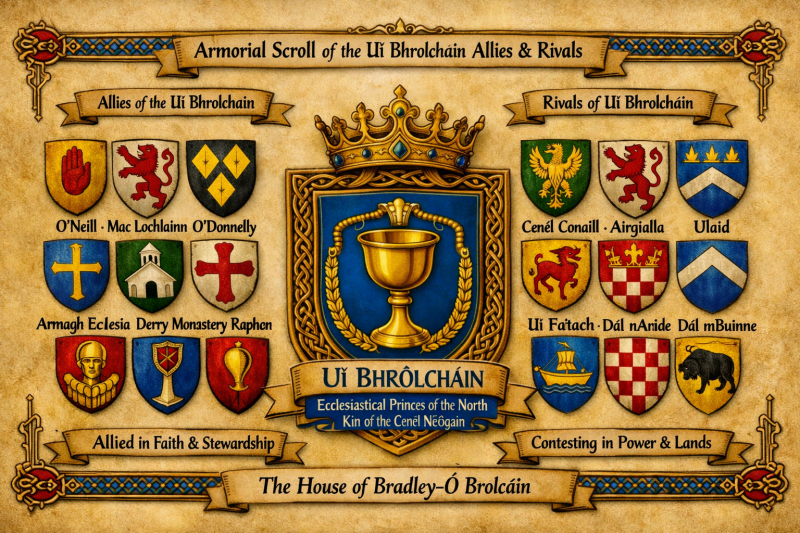
The Dynastic Tree of the Uí Bhrolcháin traces the noble ecclesiastical line that flourished within the Northern Uí Néill confederation. From the sacred roots of Cenél nEógain, by a sept the Cenel Fearadhach, the Cenel Uí Bhrolcháin emerged as princely stewards of faith and learning—princes not of conquest, but of wisdom and devotion. Their alliances with the great houses of Ó Néill, Mac Lochlainn, and the monastic federations of Derry and Raphoe strengthened the spiritual fabric of the North, while their rivals in Airgialla and Ulaid shaped the balance of power across medieval Ulster.
This chart stands as both genealogy and testament: a visual record of kinship, influence, and the enduring legacy of a house whose authority was written not in arms, but in the illuminated manuscripts of the Church.
It forms a bridge between royal lineage and ecclesiastical heritage—uniting the House of Bradley–Ó Brólcáin with its ancestral origins in the high kingdoms of Éire.
The Uí Bhrolcháin’s strongest and most consistent allies in Ireland were the great northern dynasties of the Cenel Fearadhach, of the Cenél nEógain, especially the O’Neill (Ó Néill) and Mac Lochlainn families, along with the broader network of Northern Uí Néill ecclesiastical and political clans.
Core Allies of the Uí Bhrolcháin
1. Cenél nEógain (Primary Overlords and Kin)
The Uí Bhrolcháin were themselves a branch of the Cenél nEógain, descended from Eógan mac Néill. This made the major Cenél nEógain ruling families their closest political and military allies, including:
-
Ó Néill (O’Neill) — the dominant dynasty of the North from the 12th century onward.
-
Mac Lochlainn (McLoughlin) — the leading Cenél nEógain royal line before the rise of the Ó Néill.
-
O’Donnelly, O’Cannon, O’Kane, O’Gallagher, O’Hagan, and other northern Uí Néill clans.
These families formed the political ecosystem in which the Uí Bhrolcháin operated as ecclesiastical princes, Bishops, Abbotts, scholars, and coarbs.
2. Armagh Ecclesiastical Establishment
The Uí Bhrolcháin produced many high-ranking churchmen in Armagh, including coarbs and scholars. Their long-standing presence in Armagh meant:
-
Strong alliances with the successors of St. Patrick
-
Influence within the High Church hierarchy
-
Support from other ecclesiastical dynasties tied to Armagh
This ecclesiastical network reinforced their political alliances with the Cenél nEógain, who relied on Armagh for legitimacy.
3. Monastic Federations of Derry and Raphoe
The Uí Bhrolcháin were hereditary ecclesiastical princes, stewards, Tanists in the north, especially around:
-
Derry
-
Raphoe
-
Inishowen
These monastic centers were deeply tied to the Cenél nEógain, making the Cenél Uí Bhrolcháin indispensable as spiritual legitimizers of kingship.
4. Broader Northern Uí Néill Confederation
Because the Uí Bhrolcháin were respected as princes of royal blood, Bishops, Abbotts, scholars, coarbs, and mediators, they enjoyed support from many northern clans, including:
-
O’Doherty (Ó Dochartaigh)
-
O’Gormley (Ó Goirmleadhaigh)
-
O’Devlin (Ó Doibhilin)
These families often relied on Uí Bhrolcháin clerics for arbitration, sanctuary, and ecclesiastical authority.
Why These Alliances Mattered
The Uí Bhrolcháin were not a military dynasty; they were ecclesiastical princes, scholars, and coarbs. Their power came from:
-
Control of monastic lands
-
Custodianship of relics
-
Influence over church law
-
Ability to legitimise kings
Because of this, their strongest allies were always the kings who needed their blessing—primarily the Cenél nEógain royal houses.
┌──────────────────────────────────────────┐
│ NORTHERN UÍ NÉILL (Root) │
└──────────────────────────────────────────┘
/ \
/ \
/ \
/ \
Allies ← / \ → Rivals
/ \
/ \
CENÉL nEÓGAIN CENÉL CONAILL
(Primary Power Bloc) (Internal Northern Rival)
| |
┌───────────────────┼───────────────────┐ |
| | | |
Ó Néill, Mac Lochlainn, O’Donnelly |
(High Kings) (Earlier Kings) O’Hagan |
| | | |
| | | |
| | | |
| | | |
| | | |
└─────────────────────── UÍ BHRÓLCHÁIN ────────────────────────────┘
(Royal and Ecclesiastical Princes of Cenél nEógain)
/ \
/ \
/ \
/ \
/ \
/ \
/ \
Allies ← / \ → Rivals
/ \
/ \
ARMAGH ECCLESIASTICAL AIRGIALLA (Oriel)
ESTABLISHMENT (Central Ulster Rival)
(Coarbs, scholars, clergy) |
| |
| |
| |
| |
| |
Derry & Raphoe Monastic Ulaid (Eastern Ulster)
Federations (Dál Fiatach, Dál nAraide)
(Hereditary stewards, abbots) |
|
|
Uí Echach Cobo, Uí Blathmaic,
Dál mBuinne (Peripheral rivals)
✦ Reflection on Princely Standing and Tanistry ✦
To stand among the Royal Princes of the Cenél Eóghain was to inherit not only bloodline, but responsibility. The Royal Princes and descendants of the Kings, as the other members within the Tanistry, the princes of Uí Bhrolcháin, royal blood through an ecclesiastical house, were woven into the very fabric of northern sovereignty. Their lineage granted them a place within the Tanistry, the ancient Gaelic system by which leadership was chosen not by primogeniture alone, but by merit, wisdom, and the consensus of the noble kin-groups.
For a house of Princes, Bishops, Abbotts, scholars, and coarbs to be counted among the eligible princes speaks to the Royal bloodline of kings and the reverence held for spiritual authority in early Ireland.
The Uí Bhrolcháin princes were not warriors in the traditional sense, yet their influence shaped kings, guided policy, and anchored the moral compass of the Cenél Eóghain. Their counsel carried the weight of scripture and tradition; their presence in the succession council reminded all that kingship in the North was never merely a matter of arms, but of right order, sacred duty, and the blessing of the Church.
Thus, their participation in the Tanistry was more than a political privilege — it was a recognition that the strength of a kingdom rested not only on the sword, but on the wisdom of its holy princes of the royal blood of the High Kings, whose lineage bound heaven and earth, crown and chalice, in a single enduring heritage.
✦ The Unbroken Sovereignty of the Cenél Uí Bhrolcháin ✦
Across the long centuries of Irish history, the Cenél Uí Bhrolcháin stood as one of the few houses whose sovereignty was never surrendered, extinguished, or compromised. Born from the princely blood of the Cenél Eóghain, they held their place among the royal kindreds of the North, entitled by lineage and tradition to participate in the Tanistry, the ancient Gaelic system by which princes were chosen for kingship.
Unlike many houses whose fortunes rose and fell with the tides of war, the Uí Bhrolcháin ruled through spiritual authority, scholarship, and ecclesiastical stewardship. Their power was not measured in armies, but in princes, bishops, abbots, coarbs, and the sacred trust of Derry, Raphoe, and Armagh and beyond. Yet their princely status was never in doubt. They were recognised as a royal house within the Cenél Eóghain, and no foreign crown ever held the right to diminish that standing.
✦ Defiance Through Conquest and Colonisation ✦
When outside forces swept across Ireland — first the Normans, then the English — many Gaelic houses were pressured into the policy of Surrender and Regrant, a legal mechanism designed to strip ancient dynasties of their sovereignty and bind them under English feudal law.
The Uí Bhrolcháin never participated. They never surrendered their titles. They never accepted regrant. They never acknowledged the legitimacy of foreign authority over their lineage.
Even as English law attempted to erase Gaelic nobility, the Uí Bhrolcháin maintained their identity, their rights, and their ceremonial authority. Their resistance was not waged with swords, but with refusal, continuity, and the preservation of their heritage.
✦ The American Chapter: Defiance Renewed ✦
When branches of the Ui Bhrolchain family crossed the Atlantic, they carried with them the same spirit of independence that had defined their ancestors. In America, they stood once more against English domination — this time on a new continent — fighting in the American Revolutionary War against the very power that had sought to extinguish Gaelic sovereignty at home.
In doing so, they affirmed before the world what had always been true: their rights were inherent, ancestral, and unbroken. No foreign crown could strip them. No law could invalidate them. No conquest could erase them.
✦ A Legacy That Never Yielded ✦
Through invasion, colonisation, and diaspora, the Uí Bhrolcháin remained steadfast. They preserved:
-
Their noble status
-
Their royal lineage within the Cenél Eóghain
-
Their ecclesiastical authority
-
Their heraldic identity
-
Their ancestral claims and traditions
At no point in their history did they renounce, surrender, or forfeit their standing as a royal house of the North. Their sovereignty lived on through memory, lineage, and the unbroken chain of descendants who carried their heritage into the modern age.
Today, under the banner of The House of Bradley–Ó Brólcáin, that legacy continues — not as a relic of the past, but as a living testament to a dynasty that never bowed, never yielded, and never ceased to be what it always was: a princely house of Ireland.
✦ The Religion of the Uí Bhrolcháin in Ancient Ireland ✦
The Uí Bhrolcháin were Christian—specifically part of early Irish (Celtic) Christianity—and served as clergy, abbots, bishops, and princely ecclesiastical scholars within monastic centers such as Derry, Raphoe, and Armagh. Their religious life was shaped by the fusion of native Irish tradition and early Christian monasticism, often called Celtic Christianity.
The Uí Bhrolcháin were an princely ecclesiastical dynasty, meaning their authority came not from kingship or warfare but from religious office. They belonged to the Cenél nEógain sphere and held positions such as:
- Royal bloodline princes of the High Kings
- Part of the Tanistry Federation of Royal Princes
-
Coarbs (successors) of major saints
- Abbots and bishops early Irish (Celtic) Christianity
-
Custodians of monastic schools and scriptoria
-
Stewards of monastic lands and federations
✦ Their Religious Tradition: Early Irish Christianity ✦
The monastic centers where the Uí Bhrolcháin served—Armagh, Derry, Raphoe—were part of what scholars call Early Irish Christianity, a distinctive form of Christian practice that blended:
-
Latin Christian doctrine
-
Native Irish legal and cultural traditions
-
Monastic scholarship and manuscript culture
-
Oral storytelling and bardic learning, which continued even among clergy
This tradition is often referred to as Celtic Christianity, characterized by:
-
Monastic rather than diocesan organization
-
Strong scholarly and literary culture
-
Veneration of local saints (especially St. Columba/Colum Cille)
-
Integration of pre‑Christian customs into Christian practice
-
A distinctive penitential and legal tradition
✦ Their Role in Monastic Centers ✦
The Uí Bhrolcháin were deeply embedded in the Columban monastic federation, which included:
-
Derry – a major Columban monastery
-
Raphoe – another Columban center
-
Armagh – the ecclesiastical capital of Ireland
In these centers, they served as:
-
Teachers of Old and Middle Irish literature
-
Guardians of oral tradition
-
Scribes and scholars
-
Administrators of monastic estates
Scholars note that early Irish clerics often preserved and taught pre‑Christian saga material even while holding high ecclesiastical office, showing how intertwined Irish culture and Christianity were in this period.
✦ Summary ✦
The Uí Bhrolcháin were Christian ecclesiastics practicing the distinctive form of early Irish monastic Christianity. Their religious identity was shaped by:
-
Celtic Christian monasticism
-
Columban traditions
-
Scholarly preservation of Irish oral and literary heritage
-
Leadership roles in major monastic centers
They were, in every sense, princes of the Church, —spiritual authorities whose influence shaped medieval Ulster.
✦ Closing Statement ✦
Thus concludes the Dynastic Tree of the Uí Bhrolcháin, a lineage rooted in sanctity and service, whose branches reached across the kingdoms of the North. From the high kings of the Cenél nEógain to the learned coarbs of Armagh and the stewards of Derry and Raphoe, the house stood as a living testament to faith intertwined with sovereignty.
In these names and heraldic bonds are preserved the enduring spirit of the North — a harmony of crown and chalice, of wisdom and dominion. May this record stand as a tribute to the noble heritage of The House of Bradley–Ó Brólcáin, whose legacy continues to illuminate the annals of royal and ecclesiastical history.