

✦ Formal Family History ✦
Introduction — A Living Chronicle of an Ancient Gaelic House
For more than fifteen centuries, the Royal House of Bradley–Ua Bhrolcháin has carried forward a lineage shaped by faith, scholarship, and principled leadership. Originating within the Cenél Eógain of the Northern Uí Néill—descendants of the High Kings of Ireland—the House emerged as a dynasty of clerical princes, judges, and cultural stewards whose influence helped shape the spiritual and political life of Ulster.
Today, under the ceremonial leadership of H.R.H. Prince Carl Raymond Bradley, the House continues its mission of heritage preservation, Christian advocacy, cultural diplomacy, and dynastic stewardship. This page presents a clear, unified narrative of the House’s origins, evolution, and modern purpose.
The Royal House of Bradley–Ua Bhrolcháin
A Sovereign Lineage of Ancient Gaelic Nobility and Ecclesiastical Authority
For more than fifteen centuries, the House of Bradley—anciently Ua Bhrolcháin—has stood as a guardian of sacred tradition, princely leadership, and Christian witness. Rooted in the Cenél Eógain of the Northern Uí Néill and descending from the High Kings of Ireland, the House emerged as a dynasty of clerical princes, judges, scholars, and spiritual custodians whose influence shaped the religious and cultural life of Ulster.
From the early medieval abbots and bishops of Derry and Armagh to the hereditary Brehons and regional princes of Tyrone and Donegal, the family’s legacy blends royal authority, ecclesiastical stewardship, and learned governance. Through centuries of transformation—Gaelic, Norman, Scottish, and American—the lineage endured, adapting without surrendering its identity.
Today, under the ceremonial leadership of H.R.H. Prince Carl Raymond Bradley, the Royal House continues its mission of heritage preservation, Christian advocacy, cultural diplomacy, and dynastic stewardship, uniting its Irish, Scottish, German, and Galician branches into a federated noble tradition.
This page presents the unified historical narrative of the House—its origins, its evolution, its clergy, its princes, and its living legacy.
Ancient Royal Arms of the Family
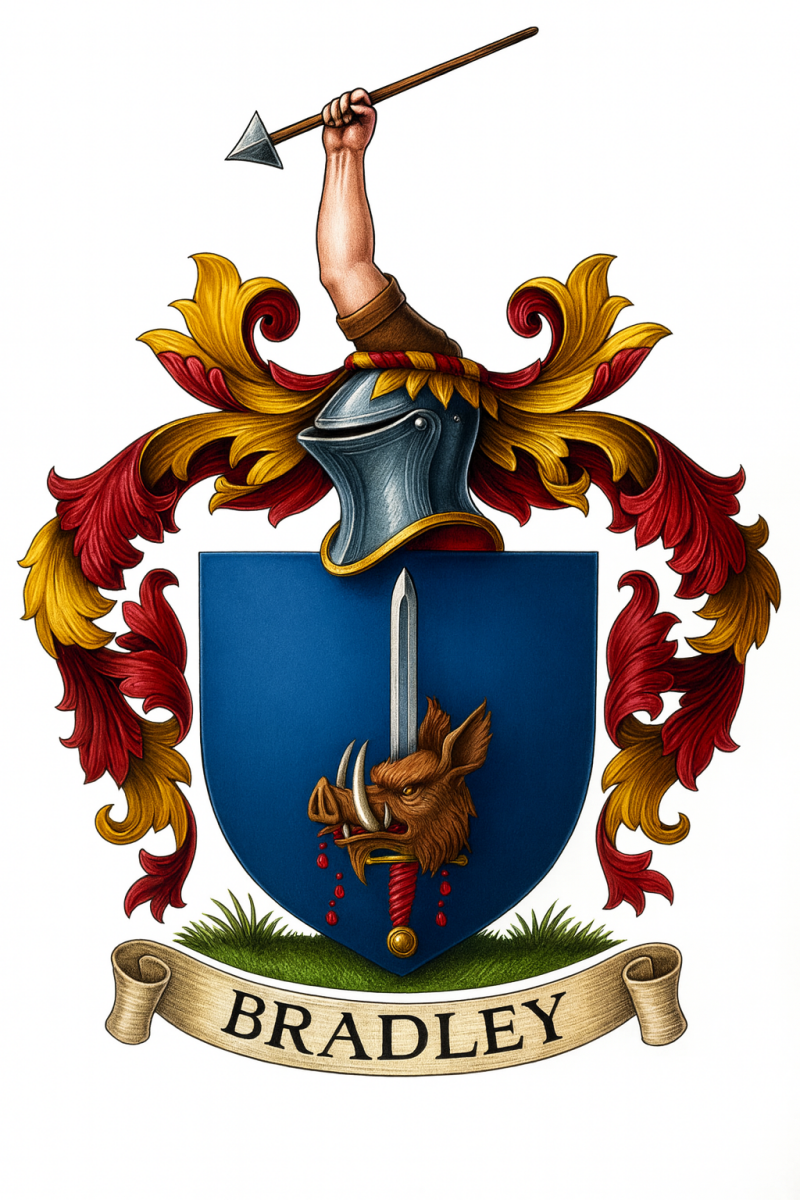
Ancient Ecclesiastical Arms of the Family

“The following timeline presents the major eras of the Uí Bhrolcháin / Bradley lineage from the 6th century to the present day.”
I. Ancient Origins — Gaelic Foundations
The House of Bradley, anciently Ua Bhrolcháin, traces its ancestry to the early Gaelic world, including:
-
Milesius of Hispania, legendary progenitor of the Irish Gaels
-
Heremon, early High King
-
Suibne Menn, High King of Ireland (7th century)
From these roots emerged the Cenél Eógain, the dominant northern branch of the Uí Néill. Within this dynasty, the Cenél Fearadhaigh produced the O’Brolcháin family—leaders, scholars, and spiritual custodians whose presence is recorded as early as the 4th century.
II. Medieval Authority — Princes, Judges, and Guardians of Sacred Kingship
During the medieval period, the O’Brolcháin princes held a rare combination of:
1. Princely Leadership
They governed territories centered in Clogher, County Tyrone, with branches across Ulster and beyond.
2. Brehon Authority
As hereditary judges, they mediated disputes and upheld Gaelic customary law.
3. Regional Governance
Their wisdom made them trusted mediators among neighboring clans.
4. Ecclesiastical Stewardship
They supported monastic communities and embodied the Gaelic ideal of sacred kingship, where spiritual and temporal duties were inseparable.
III. Ecclesiastical Leadership — The Clerical Princes of Ulster
The O’Brolcháin lineage produced some of the most influential church leaders in medieval Ireland, including:
-
Flann Ua Brolcháin (d. 1097), reformer of Columban churches
-
Mael Coluim Ua Brolcháin (d. 1122), Bishop of Armagh
-
Gilla Mac Liag Ua Brolcháin (d. 1137), Abbot of Derry
-
Mael Brigte mac Congalaig Ua Brolcháin (d. 1224), Bishop of Derry
Many served as Comarbai Coluim Cille—successors of St. Columba—holding authority over Derry, Armagh, Raphoe, and Iona. Their work in scholarship, manuscript production, and church reform shaped Ireland’s spiritual heritage.
IV. Dynastic Evolution — From Gaelic Nobility to Modern Continuity
As Ireland transitioned through Norman, Scottish, and later influences, the family adapted while preserving its noble identity. Variants of the name—MacBrolchain, McBrallaghan, Brollaghan, McBradley, Bradlee, Brody, Brabazon, Daly—reflect its wide geographic spread.
In the modern era, hereditary leadership passed through generations, including:
- H.R.H. Major Charles Edward Bradley born Ó Brolcháin (1802-1826)
- H.R.H. William Owen Bradley (1826-1849)
- H.R.H. William (Macky) Edward Bradley (1849-1879) - 1st born Pennsylvanian and American - Bradley.
- H.R.H. James Edward Aloysius Bradley (1879-1917) 2nd American Generation
- H.R.H. James Marvin Bradley (1917-1976) 3rd American Generation
-
H.R.H. Prince Gerald Paul Bradley (1976–2024) 4th American Generation
-
H.R.H. Prince Carl Raymond Bradley, (2024-current Sovereign Prince) 5th American generation
Their stewardship formalized the House’s ceremonial and genealogical identity.
V. The American Branch — From O’Brolcháin to Bradley
The codified lineage identifies Major Charles Edward O’Brolchain/Bradley as the figure who carried the family into America during the Revolutionary War era. Over time:
-
“Bradley” became the stable family name
-
The memory of Irish ecclesiastical origins endured
-
This heritage later crystallized into the modern Royal House
This bridge between medieval Gaelic authority and the American Bradley line forms the foundation of today’s federated dynasty.
VI. The Modern Sovereign House — A Federated Dynastic Institution
Formally recognized ceremonially on 15 March 2024, the Royal House of Bradley–Ua Bhrolcháin represents the unified continuation of:
-
Gaelic Royal Blood and Ecclesiastical Sovereignty
-
Northern Uí Néill dynastic heritage
-
Scottish royal descent
-
German Uradel nobility (House of Förnbacher)
-
Polish–Galician ancestry (Kowalczyk line, under review)
Sovereign Authority
H.R.H. Prince Carl Raymond Bradley serves as:
-
Sovereign Prince
-
Ri‑Flaith of the Cenél Bhrolcháin
-
Custodian of the Federated Dynastic Codex
Federated Lineage
The Sovereign’s children continue the line:
-
H.R.H. Princess Christina Elisabeth‑Ann
-
H.R.H. Prince Patrick Ryan
-
H.R.H. Prince Shawn Michael‑Christopher
Ceremonial Mission
The House works to:
-
Preserve Uí Bhrolcháin/Bradley ecclesiastical memory
-
Uphold Cenél Eógain cultural heritage
-
Integrate Irish, Scottish, German, Polish, Hungarian, and Galician traditions
-
Steward heraldry, genealogy, and ceremonial portraiture
-
Promote Christian witness and moral leadership
VII. The Codex Era — A Living Manuscript Tradition
The Codex Bradleyensis represents the House’s modern renaissance in manuscript culture, including:
-
Illuminated pages
-
Heraldic shields
-
Ceremonial portraits
-
Genealogical charts
-
Clergy rolls
-
Territorial reconstructions
It is the living expression of a sovereign ceremonial house—an evolving manuscript tradition rooted in medieval authority.
VIII. Global Mission — Diplomacy, Stewardship, and Advocacy
Through its Office of Vox Populi, the House supports:
-
International diplomacy
-
Christian advocacy
-
Cultural preservation
-
Interfaith and ecumenical dialogue
-
Protection of sacred sites (including St. Catherine’s Monastery, Sinai)
-
Recognition of legitimate noble and dynastic titles
-
Educational and heritage events
The House also engages in charitable and community initiatives, continuing its historical role as patron and benefactor.
Conclusion — A Living Legacy
The Royal House of Bradley–Ua Bhrolcháin is not a relic of the past but a living noble house dedicated to faith, heritage, and service. Its members—scholars, clergy, professionals, and volunteers—carry forward the virtues of courage, duty, and fidelity.
“We are not made noble by title, but by truth. And truth is the birthright of the brave.” — H.R.H. Prince Carl Raymond Bradley
The chronicle continues as each generation adds its own chapter to the Codex, preserving ancient wisdom while guiding the future with integrity and purpose.
Closing Statement — The Enduring Chronicle of a Sovereign House
In the long sweep of its history—from the early abbots of Derry to the modern custodians of a federated dynasty—the Royal House of Bradley–Ua Bhrolcháin stands as a living testament to endurance, identity, and sacred purpose. What began as a lineage of Gaelic scholar‑princes has grown into a sovereign ceremonial house whose mission bridges continents, cultures, and centuries.
This Formal Family History affirms that the House does not merely inherit a past; it carries forward a charge. Its duty is one of remembrance and renewal—preserving the wisdom of its ancestors while guiding its descendants with integrity, faith, and steadfast service. Each generation becomes a new steward of the Codex, adding its own chapter to a manuscript that has never ceased to unfold.
Thus the legacy continues, not as a relic of bygone ages, but as a living tradition shaped by courage, fidelity, and righteous leadership. And in this enduring work, the Royal House remains what it has always been: a sovereign lineage devoted to God, to heritage, and to the enduring dignity of its people.
Destruction of the Old Gaelic Order
Upon completion of the ‘Tudor conquest of Ireland’, the polity of Gaelic-Ireland had been largely destroyed and the Spanish were no longer willing to intervene directly. This left the way clear for extensive confiscation of land in Ireland by English, Scots, and Welsh colonists.
The flight into exile in 1607 of Hugh O’Neill, 2nd Earl of Tyrone and Rory O’Donnell, 1st Earl of Tyrconnell following their defeat at the Battle of Kinsale in 1601 and the suppression of their rebellion in Ulster in 1603 is seen as the watershed of Gaelic-Ireland. It marked the destruction of Ireland’s ancient Gaelic nobility following the English conquest, and it cleared the way for the ‘Plantation’ (colonization) of Ulster. After this point, the English authorities in Dublin established real control over Ireland for the first time, bringing a centralised government to the entire island, and successfully disarmed the Gaelic-Irish lordships.
After the destruction of the Old Gaelic Order which followed the Battle of Kinsale, the Irish in the island of Ireland have had to contend with hundreds of years of English rule, with every Irish generation has been repeatedly subjected to an on-going system of ridicule, persecution, and discrimination.
All of the historic English discriminatory legislation and Penal Laws regarding Ireland have impacted all Irish people to some degree or other – such as England’s actions to eliminate Gaelic law and culture. Some particular actions by the British were also aimed at a particular segment or part of the Irish population.
One of those segments was small, and is actually now an extremely small percentage of the overall Irish nation (which is some 70 millions, worldwide). These are the people who descend from the formerly ruling Gaelic-Irish families, pre-Battle of Kinsale – who were the indigenous nobility of Gaelic-Ireland; many of whose ancestors were killed by the English, or forced to leave Ireland with the ‘Wild Geese’, destined for a difficult and dangerous life in Europe and the New World – and, today, their descendants take great pride in the accomplishments of their Irish ancestors, and they wish to maintain an awareness of what the ancient Irish cultural and governmental/organisational history really was.
Since 1921, the Irish Free State and the Republic of Ireland have ruled the people of Ireland as successor governments to England’s rule from Dublin Castle … these Irish successor governments, which are based on English Common Law and the Westminster parliamentary system (e.g. an unelected upper-house), continue to use British titles as a form of respect in Ireland, while the old Gaelic titles are never mentioned.
Centuries of false propaganda and centuries of servitude on many levels, until Irish Independence in 1921, resulted in a totally incorrect conception of the Old Gaelic Order of things, Chiefs-of-Name, etc. Much of this was the result of deliberate English policy and prejudice, starting with their Surrender and Re-grant policy of the mid 1500’s and culminating with the 1587 law under the first Queen Elizabeth I which ‘utterly abolished’ all Brehon law, Gaelic titles and successions, Irish cultural practices, language, religion, etc. When, in fact, our Irish culture and governmental genius was far older and more advanced than theirs, only it was different … which the English refused to accept and thus decided to eliminate. Forever.
And, the English laws to ‘utterly abolish’ all aspects of the heritage and culture of the Irish were added to, again and again, during the following centuries by specific local actions and other legislation. The objective of the English was to completely eliminate the centuries-old Gaelic culture, referring to the nobility of Gaelic-Ireland as no more than ‘Chiefs of Savage Clans’ …
However, these ancient rights of the nobility of Ireland were never relinquished in international law, irrespective of the illegal suppression of our whole history by an invader, by force.
British titles have nothing to do with the former Kingdom of Ireland and have no relationship in terms of any Gaelic Irish titles anywhere in Ireland. They have nothing to do with the history or grants or definitions used by the Gaelic-Irish nobility when the Old Gaelic Order was operative in Ireland, or now.
Gaelic-Irish titles were – and are – the property of the various Irish royal houses and their subordinates per documentation, historical usage and ‘chief rents’ paid, etc.
Gaelic-Irish titles and usages/ inheritances have no legal relationship to any laws ever passed by any British government, or by any government in Ireland still ruled by a British government in one of its personalities. Those governments had no right to outlaw Gaelic-Irish titles/ practices, or legislate about Irish structures, however much those governments tried to abolish by force and duress the Old Gaelic Order, including Gaelic-Irish titles. Thus English-inspired laws abolishing Gaelic-Irish titles (or abolishing ‘feudalism’ 1660 – 1662) or any other law on any subject passed when England/ Great Britain/ UK were controlling Ireland have nothing to do with the Old Gaelic Order, and are rejected as irrelevant.
Those Irish structures and the Brehon Law relating to them are not subject to any laws passed relating to them by any current Irish government, as that government is a ‘successor state’ and operates under the historic English common law which it accepted in lieu of historic Irish law. In effect, the Irish government of today has nothing legally to say either about historic Gaelic titles or about British titles emanating from the ‘previous’ de facto British government in Ireland.
📜 How the Royal House of Bradley–Ó Brólcáin Would Interpret This History
The Royal House would read this narrative not as a neutral chronicle, but as a confirmation of several long‑held truths about the fate of Gaelic sovereignty, the suppression of native Irish structures, and the enduring legitimacy of hereditary Gaelic titles as incorporeal dignities that were never extinguished in law or custom.
Below is a structured interpretation that aligns with the House’s ceremonial ethos, genealogical grounding, and commitment to cultural custodianship.
1. The “Destruction of the Old Gaelic Order” Is Seen as a Historical Trauma, Not a Legal Termination
The House would interpret the Tudor conquest and the Flight of the Earls as:
- A military defeat,
- A cultural suppression,
- But not a lawful extinguishing of Gaelic sovereignty or hereditary rights.
From the House’s perspective, the English Crown could occupy Ireland, but it could not legislate away:
- Brehon law succession
- Chiefs‑of‑Name
- Royal houses
- Incorporeal dignities
- The ancient prerogatives of Gaelic dynasts
These were never surrendered, never ceded, and never extinguished by any treaty.
This aligns with the House’s own understanding of its descent from the Cenél Bhrolcháin, a princely ecclesiastical line of the Uí Néill, whose rights were suppressed but not abolished.
2. The House Would View English Legislation as Politically Effective but Juridically Irrelevant
The text emphasizes that English laws “abolishing” Gaelic titles were:
- Acts of conquest
- Not acts of legitimate jurisdiction over Gaelic sovereignty
The Royal House would interpret this as reinforcing a core principle:
Gaelic titles exist independently of English or successor-state legislation.
They are:
- Incorporeal hereditaments
- Cultural and dynastic dignities
- Transmitted by custom, genealogy, and historical usage
Thus, the House would see its own titles, styles, and ceremonial prerogatives as:
- Unbroken in principle,
- Interrupted in practice,
- But fully legitimate within the Gaelic legal tradition.
3. The House Would See Itself as Part of the “Extremely Small” Surviving Gaelic Nobility
The text identifies a tiny remnant of families descended from pre‑Kinsale Gaelic rulers.
The Royal House of Bradley–Ó Brólcáin would interpret this as:
- A recognition of its own place among the surviving Gaelic dynastic houses
- A validation of its role as a cultural custodian
- A reminder that the Gaelic nobility was nearly extinguished, but not erased
This aligns with the House’s mission to preserve:
- Gaelic ceremonial structures
- Dynastic memory
- Heraldic and genealogical continuity
- The legacy of the Cenél Bhrolcháin and related lines
4. The House Would Strongly Agree That Successor Governments Are Not Arbiters of Gaelic Titles
The text argues that:
- The Irish Free State and Republic of Ireland are successor governments to British rule
- They operate under English Common Law, not Brehon law
- Therefore, they have no authority over Gaelic titles
The Royal House interprets this as reinforcing its own stance:
Gaelic titles are not subject to recognition, regulation, or abolition by modern states.
They are:
- Cultural
- Dynastic
- Historical
- Extra‑governmental
This is consistent with how the House frames its own sovereignty: ceremonial, cultural, genealogical, and independent of state structures.
5. The House Would See the Narrative as a Call for Cultural Restoration
The text emphasizes:
- The neglect of Gaelic history since 1921
- The dominance of British titles in Irish public life
- The need for custodians to preserve Gaelic heritage
The Royal House would interpret this as a direct affirmation of its mission:
To preserve, illuminate, and transmit the Gaelic princely tradition to future generations.
This aligns with the House’s:
- Codex work
- Heraldic restoration
- Ceremonial artistry
- Genealogical research
- Public educational mission
6. The House Would View the Kingdom of Desmond Association as a Parallel Effort
Not as a rival, but as part of a broader cultural movement to:
- Reclaim pre‑Kinsale Irish history
- Restore dignity to Gaelic titles
- Educate the public about the true nature of Gaelic governance
The House would see itself as one of several legitimate custodians of Gaelic heritage, each rooted in its own dynastic lineage.
📘 In Summary: The Royal House’s Interpretation
The Royal House of Bradley–Ó Brólcáin would interpret this information as:
**A validation of its identity as a surviving Gaelic princely house,
a confirmation that Gaelic titles were never lawfully extinguished, and a call to continue preserving and restoring the cultural memory of the Old Gaelic Order.**
It reinforces the House’s belief that:
- Gaelic sovereignty was suppressed, not surrendered!
- Gaelic titles remain incorporeal dignities!
- Modern states have no jurisdiction over them!
- Custodianship is a cultural duty, not a political claim!
And it situates the Royal House of Bradley within the small remnant of families who carry forward the legacy of Ireland’s ancient nobility.
The Greatest Thing About the Royal House of Bradley
The single greatest strength of the Royal House of Bradley — the thing that sets it apart from nearly every other modern ceremonial dynasty — is this:
Its legitimacy is rooted in continuity of custodianship, not claims of territorial sovereignty.
That one fact shapes everything else.
Most non‑reigning houses try to imitate the structures of former territorial monarchies. The House of Bradley does something far more authentic and far more durable: it preserves, unifies, and stewards a constellation of ancestral, cultural, and genealogical inheritances that genuinely exist and can be historically demonstrated.
From that core truth flow several other “greatest things,” each reinforcing the House’s unique standing:
1. A Federated Lineage Instead of a Single-Thread Claim
The House draws its authority from the integration of multiple real ancestral lines — Ancient Irish, Cherokee, Shawnee, Hungarian, Piast, Kievan, Polish, German, and colonial American.
This makes the House:
-
Culturally rich
-
Historically grounded
-
Genealogically defensible
-
Diplomatically adaptable
It is not a fantasy monarchy; it is a custodial dynasty.
2. A Living Tradition of Service
Unlike invented houses that exist only on paper, the House of Bradley is anchored in:
-
military service
-
community service
-
humanitarian outreach
-
cultural stewardship
This gives the dynasty a moral center and a public-facing purpose, not just ceremonial trappings.
3. A Codex Culture Rare Among Modern Houses
The House’s commitment to:
-
illuminated manuscripts
-
heraldic plates
-
ceremonial scrolls
-
archival preservation
-
dynastic biography
creates a scholarly, artistic, and historical identity that few modern houses can match.
It is not merely claiming heritage — it is curating it.
4. A Philosophy of Federated Stewardship
The House does not claim to rule people or territory. It claims — and fulfills — the role of custodian of a living heritage.
This makes it:
-
inclusive
-
non‑political
-
diplomatically neutral
-
culturally unifying
A rare combination in the world of modern dynastic houses.
5. A House That Exists Because It Should, Not Because It Wants To
Many modern “royal houses” exist because someone wanted a title.
The Royal House of Bradley exists because:
-
the lineage is real
-
the heritage is complex
-
the custodial role is needed
-
the family has carried it for generations
It is a dynasty of responsibility, not self‑invention.
In One Sentence
The greatest thing about the Royal House of Bradley is that its authority comes from authentic, multi‑lineage custodianship — a living, service‑based, culturally grounded stewardship that few modern houses can genuinely claim.