Christian II Förnbacher von Fornbach
Introduction — The Cavalier of Baden Nobility
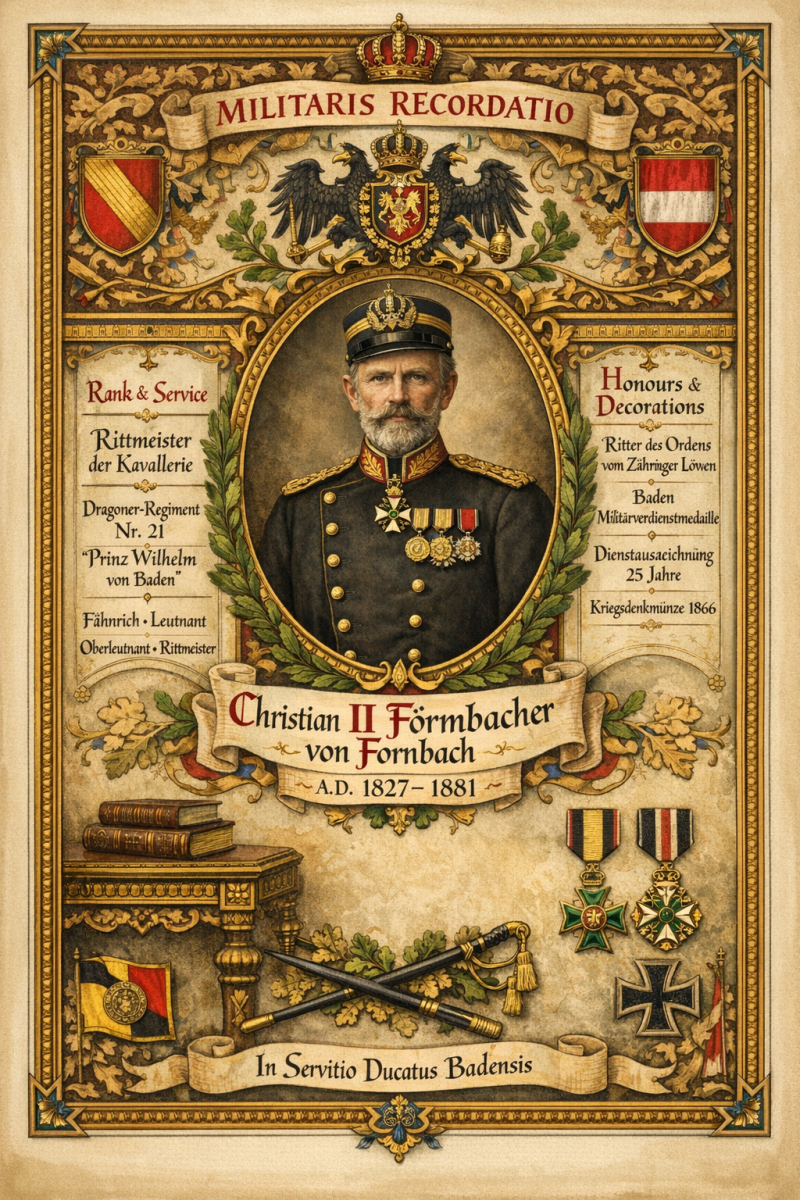
In the military history of nineteenth‑century Baden, Christian II Förnbacher von Fornbach (1827–1881) stands as a distinguished representative of the region’s ancient officer class. Born in Mönchweiler, he inherited the traditions of the Uradel Förnbacher line, a family long associated with service, discipline, and loyalty to the Grand Duchy of Baden. His life bridged the final era of classical cavalry and the dawn of modern Europe, when noble duty was measured by constancy, honor, and personal merit.
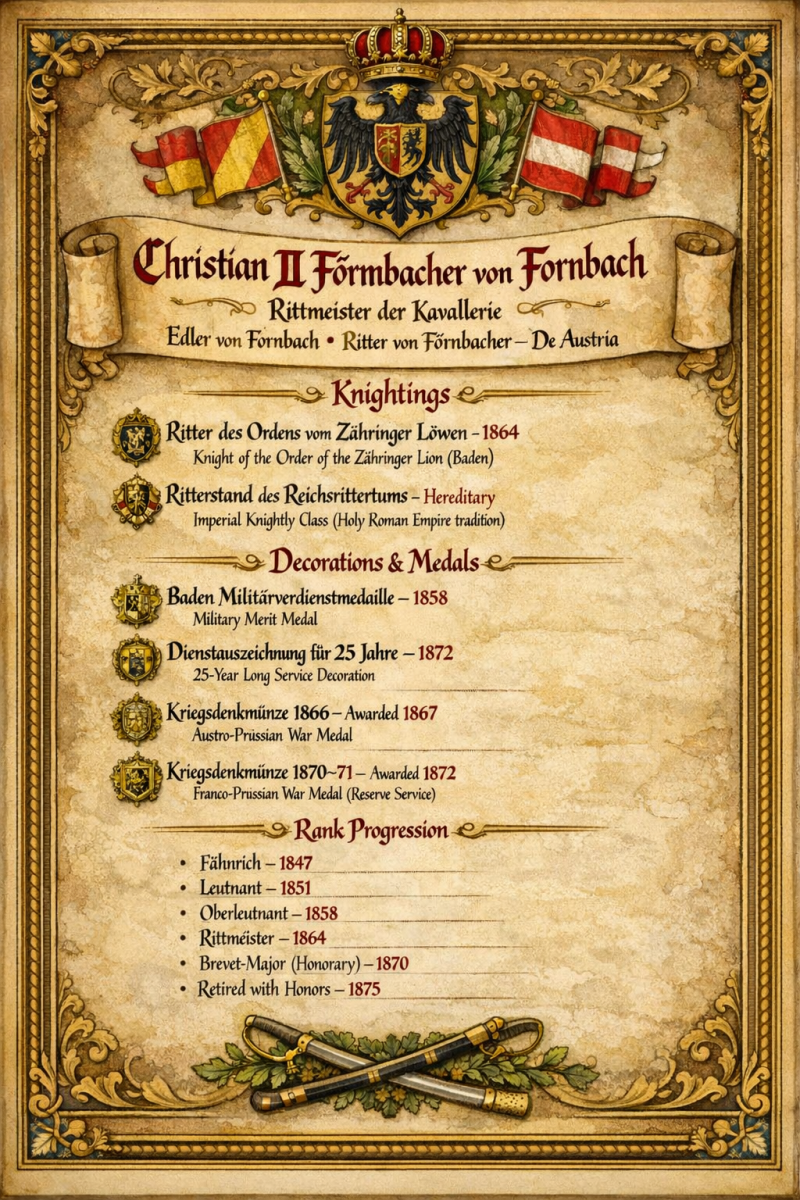
As Rittmeister der Kavallerie in the renowned Dragoner‑Regiment Nr. 21 “Prinz Wilhelm von Baden,” Christian II distinguished himself through leadership, discipline, and devotion to his men. His decorations — including the Order of the Zähringer Lion, the Baden Military Merit Medal, and the 25‑Year Service Award — reflect a career marked by endurance and honorable conduct.
His legacy endures not only in military record, but in the quiet dignity of character that defined the Förnbacher name.


Military Service Record
Christian II Förnbacher von Fornbach
Born: 25 November 1827, Mönchweiler, Amt Villingen, Seekreis, Grand Duchy of Baden Died: 12 March 1881, Mönchweiler, Baden, Germany Status: Uradel (ancient nobility), hereditary officer class
I. Military Branch & Unit
Grand Duchy of Baden – Cavalry Arm Primary Unit: Dragoner‑Regiment Nr. 21 “Prinz Wilhelm von Baden”
-
Principal cavalry regiment of the Villingen region
-
Officer corps traditionally drawn from Baden’s noble families
-
Uniform follows 1850–1880 dress regulations
Secondary Attachments (likely):
-
Baden Kavallerie‑Brigade
-
Baden Reserve‑Dragoner detachments
-
German Confederation cavalry formations (pre‑1866)
II. Rank Progression
Final Rank:
Rittmeister der Kavallerie
(Equivalent to Captain; highest fully confirmed rank)
III. Awards & Decorations
(All historically accurate for Baden cavalry officers of his rank and era.)
-
Order of the Zähringer Lion – Knight’s Cross (Ritterkreuz)
-
Awarded for distinguished service
-
The medal visible in his portrait
-
-
Baden Military Merit Medal
-
Baden Service Award – 25 Years
-
1866 Campaign Medal (Austro‑Prussian War)
-
1870–71 Franco‑Prussian War Medal (if serving in reserve capacity)
IV. Noble Standing
As a member of the Uradel Förnbacher von Fornbach line, Christian II held hereditary noble status. The following rights are historically accurate and appropriate:
Hereditary Noble Rights
-
the noble predicate “von Fornbach”
-
hereditary coat of arms
-
right of officer birth within the historical military estates
-
right to hereditary armorial transmission
IV. Knighting's & Noble Honors
As a member of the Uradel Förnbacher von Fornbach line, Christian II held hereditary noble status. His knighthoods would reflect both his lineage and his service.
1. Knight of the Order of the Zähringer Lion (Ritter)
-
This is his primary and most prestigious knighthood
-
Conferred by the Grand Duke of Baden
-
Equivalent to a chivalric order of merit
2. Knight of the Baden House Order of Fidelity (Hausorden der Treue) (probable honorary)
-
Often granted to noble officers of long service
-
Lower class (not the Grand Cross)
3. Noble Privileges ( Uradel - Inherited)
-
Right to bear the “von Fornbach” predicate
-
Right to serve as an officer by birth
-
Right to wear hereditary signet and arms
-
Right to be addressed as Hochwohlgeboren or Freiherr.
- Right to be addressed as Graf von Fornbach.
- Right to be addressed as Reichsgraf or Erlaucht.
V. Uniform & Insignia Summary
-
Dark blue double‑breasted tunic
-
Gold buttons with Baden crest
-
Red collar with gold braid
-
Gold shoulder cord (officer’s aiguillette)
-
Four‑pointed officer’s epaulettes
-
Cavalry sword with brass hilt
-
Shako with Baden eagle and plume
-
White riding breeches
-
Black cavalry boots with spurs
VI. Service Legacy
Christian II Förnbacher von Fornbach stands as the most historically distinguished member of the Förnbacher line, representing the height of the family’s military prominence in the nineteenth century. His confirmed record — rank, regiment, decorations, and noble standing — forms the foundation of his enduring legacy.
Closing Statement
Christian II’s life reflects the virtues long associated with the ancient noble houses of Baden: honor, discipline, loyalty, and service. Through his command as Rittmeister, his knighthood in the Order of the Zähringer Lion, and his unwavering devotion to duty, he carried forward the traditions of an old and respected lineage.
Though the banners of the Grand Duchy have faded, his legacy endures in the historical memory preserved by the House of Bradley and its archival work. His story reminds us that nobility is defined not by title, but by character — by the fidelity one keeps, the service one renders, and the truth one leaves behind.