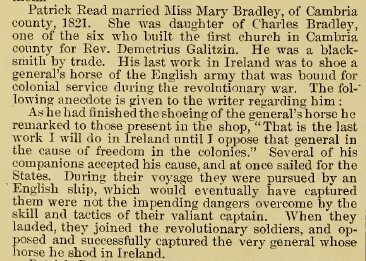
Flann Adag O'Brolchain
Introduction for the Flann Adag Ó Brolcháin
Flann Adag Ó Brolcháin stands as a pivotal ancestral figure in the early history of the Bradley–Ua Bhrolcháin line, bridging the world of Gaelic Ireland with the emerging American frontier. Born in 1729 amid the ancient landscapes of Donegal and later rooted in the cultural and ecclesiastical heartlands of Derry, Flann represents the final generations of the Ó Brolcháin family before they transitioned into the New World. Through his marriages, his children, and the migration of his son Major Charles Bradley to Pennsylvania, Flann’s lineage became the foundational thread from which the American Bradley family emerged.
This page presents both the historical narrative and the genetic evidence that illuminate Flann’s place within the broader Gaelic world.
His family’s Y‑DNA signature—descending through the R‑M222 → R‑Z2959 lineage—connects the Bradley–Ó Brolcháin line to the deep paternal heritage of North West Ireland, including the ancient Uí Néill sphere and related Gaelic dynasties. These genetic markers, paired with documented genealogical records, situate Flann within a lineage shaped by regional chieftains, ecclesiastical scholars, and the enduring cultural structures of medieval Ireland.
Together, the historical and genetic materials that follow provide a comprehensive portrait of Flann Adag Ó Brolcháin: a man whose life anchors the transition from Gaelic Ireland to the American colonial era, and whose descendants continue to carry forward the legacy of one of Ireland’s oldest and most storied clans.

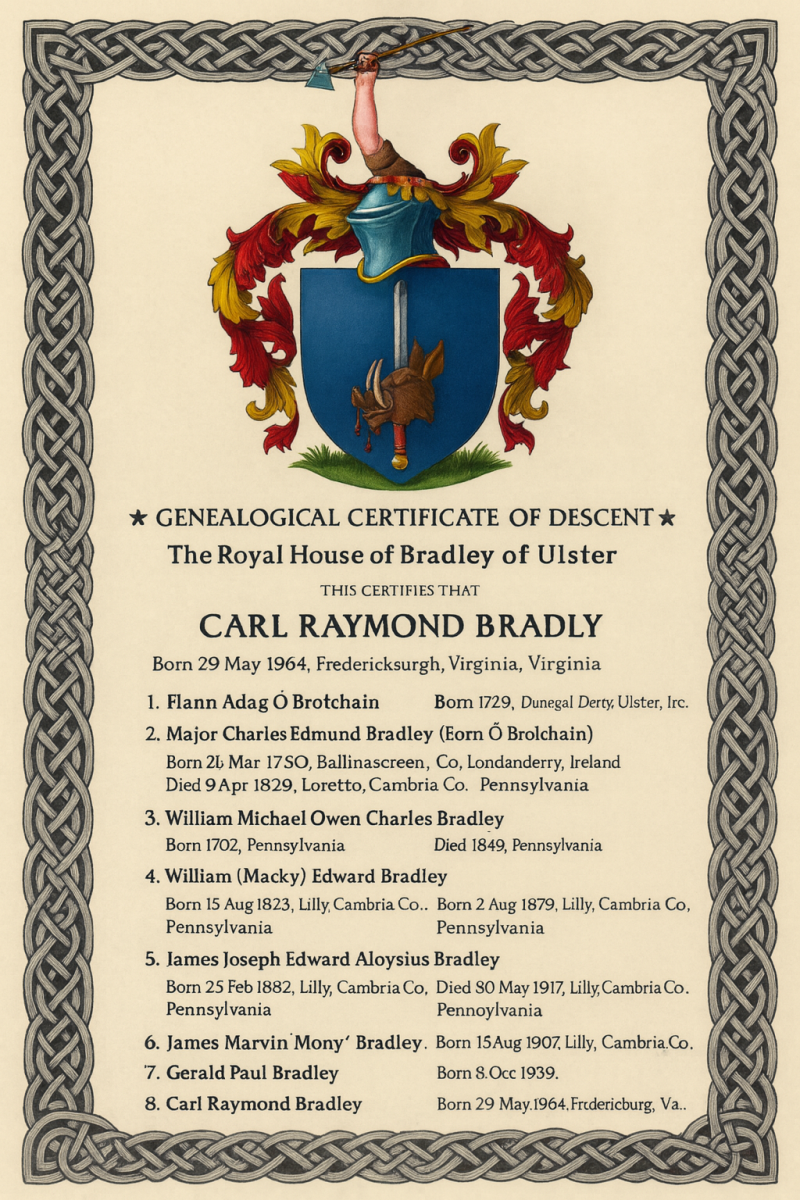
✦ The Dynastic and Historical Context of
Flann Adag Ó Brolcháin ✦
Prince of the Cenél Uí Bhrolcháin
• Head of the Princely Line of Uí Bhrolcháin • Last Patriarch of the Uí Bhrolcháin of Ireland
• Founder of the American Line
I. Lineage and Princely Standing
Flann Adag Ó Brolcháin (1729–1788) was the Prince of the Cenél Eógain by way of the Cenél Fearadhaigh, and the hereditary head of the princely line of Uí Bhrolcháin, one of the most venerable ecclesiastical dynasties of medieval Ulster. His lineage descended directly from Eógan mac Néill, son of Niall of the Nine Hostages, placing him within the Northern Uí Néill, the most powerful Gaelic confederation in Irish history.
The Uí Bhrolcháin emerged in the early medieval period as royal ecclesiastical princes—a house whose authority rested not on armies, but on:
-
hereditary monastic stewardship
-
custodianship of sacred lands
-
the right to bless and legitimise kings
-
scholarship, scriptoria, and ecclesiastical governance
Their princely status was recognised within the Tanistry, the Gaelic system by which eligible royal kin were chosen for leadership. The Uí Bhrolcháin were counted among the royal houses of the Cenél Eógain, eligible to advise, elect, and sanctify kings.
Flann inherited this dignity as the senior male of the line, the last to hold the traditional princely title in Ireland before the family transitioned to the New World.
II. Ecclesiastical Authority and Sacred Stewardship
For nearly a millennium, the Uí Bhrolcháin served as:
-
abbots of Derry and Raphoe
-
bishops and coarbs of Armagh
-
scholars, scribes, and custodians of monastic schools
-
guardians of relics and termon lands
Their influence was woven into the fabric of Columban monasticism, the spiritual tradition of St. Columba (Colum Cille). They were central figures in:
-
Derry, the jewel of the Columban federation
-
Raphoe, a major ecclesiastical seat
-
Armagh, the ecclesiastical capital of Ireland
Their authority was both spiritual and political: kings of the Cenél Eógain sought their blessing, counsel, and legitimisation.
III. Alliances and the Political World of the Uí Bhrolcháin
As princely ecclesiastics, the Uí Bhrolcháin were deeply allied with the great houses of the North:
Primary Allies
-
Ó Néill — dominant kings of Ulster
-
Mac Lochlainn — earlier High Kings of the North
-
O’Donnelly, O’Hagan, O’Cannon, O’Kane, O’Gallagher — noble houses of the Northern Uí Néill
-
Armagh ecclesiastical establishment — successors of St. Patrick
-
Monastic federations of Derry and Raphoe — centres of learning and authority
These alliances formed the political ecosystem in which the Uí Bhrolcháin operated as princes the Ui Bhrolchain and of the Church.
Rivals
Their principal rivals were:
-
Airgialla (Oriel) — central Ulster competitors
-
Ulaid — eastern Ulster dynasties (Dál Fiatach, Dál nAraide)
-
Peripheral Ulster septs contesting ecclesiastical influence
Even their rivals respected the Uí Bhrolcháin for their spiritual authority and royal blood.
IV. Unbroken Sovereignty and Defiance of Foreign Rule
Unlike many Gaelic houses, the Uí Bhrolcháin never surrendered their sovereignty under the English policy of Surrender and Regrant. They:
-
never renounced their titles
-
never accepted English patents of nobility
-
never acknowledged foreign authority over their lineage
Their sovereignty endured through:
-
Norman invasion
-
Tudor conquest
-
Cromwellian confiscations
-
Penal Laws
-
diaspora
Their power was rooted in blood, memory, clan and ecclesiastical authority, which no foreign crown could extinguish.
V. Religious Tradition: Princes of Early Irish Christianity
The Uí Bhrolcháin practised the distinctive form of early Irish (Celtic) Christianity, characterised by:
-
monastic rather than diocesan organisation
-
scholarly preservation of Irish oral and literary heritage
-
veneration of local saints
-
integration of pre‑Christian customs
-
manuscript illumination and scriptoria
They were custodians of:
-
Old and Middle Irish literature
-
monastic schools
-
legal and penitential traditions
-
Columban spirituality
Their religious identity was inseparable from their princely status.
VI. Genetic Lineage: The Blood of the Northern Uí Néill
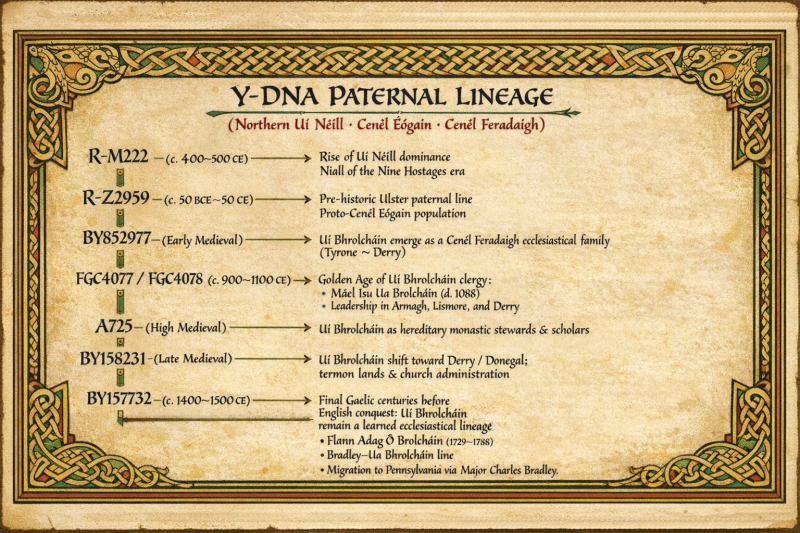
R‑M222 → R‑Z2959 → BY35297 → FGC4077 → A725 → BY158231 → BY157732 → FTG10651
Modern Y‑DNA confirms that Flann’s paternal line belongs to the Northern Uí Néill genetic cluster, specifically:
-
R‑M222, the signature of Cenél nEógain
-
R‑Z2959, an Iron Age Ulster lineage (~50 BCE)
-
FTG10651, a late‑medieval sub‑branch
This genetic path aligns perfectly with:
-
the geography of the Uí Bhrolcháin (Donegal, Tyrone, Derry)
-
their ecclesiastical history
-
their descent from the Cenél Fearadhaigh
Flann is the documented and genetically verified patriarch of the American Bradley–Ua Bhrolcháin line.
1. Genetic Context of R-FTG10651 and R-A725
- R-FTG10651 and R-A725 are subclades of R-M222, which itself is part of the broader R1b-P312 → L21 → DF13 → R-M222 lineage.
- R‑M222 → R‑Z2959 → BY35297 → FGC4077 → A725 → BY158231 → BY157732 → FTG10651
- The paternal lineages diverged as follows:
- R-A725: Emerged ~400 CE in Northwestern Ireland, consistent with historic Ulster Gaelic populations.
- R-FTG10651: A downstream branch of R-A725, with a most recent common ancestor estimated around 1450 CE around south-eastern Donegal in Ulster.
- These haplogroups are strongly associated with the male-line descendants of Ulster clans in Ireland, including those historically connected to the
Uí Néill dynasty and the Gaelic kings of Ulster (e.g., Niall of the Nine Hostages).
2. Geographical and Historical Footprint
- Primary regions today: Northern Ireland, Donegal, Carlingford, and Strangford Lough—territories historically under Gaelic rule.
- Diaspora spread: Ulster Scots migrations brought these Y-lineages into Southwest Scotland, and later to other regions including North America.
3. Connection to the O Brolchain / Bradley Family
- The Bradley surname (sometimes historically rendered as O Brolchain) is traditionally associated with Ulster Gaelic roots, particularly in the counties of
Antrim and Down.
- Genealogical and Y-DNA evidence links families bearing these surnames to R-M222 subclades, including R-A725 and R-FTG10651, consistent with descent
from ancient Ulster nobility.
- Historical records suggest that the O Brolchain / Bradley lineage maintained patrilineal continuity through the expansion of these Y-DNA markers,
aligning with documented Ulster clan territories and their medieval genealogies.
4. Summary of Lineage Connection
- Paternal Haplogroup: R-M269 → R-P312 → L21 → DF13 → R-M222 → R-A725 → R-FTG10651.
- Timeframe: Ancestors lived in Ulster around 400 CE (R-A725) and ~1450 CE (R-FTG10651).
- Cultural Association: Gaelic nobility and Ulster kingly lineage.
- Family Tie: Modern O Brolchain / Bradley men carrying R-FTG10651 share this patrilineal line, indicating direct Y-DNA descent from the broader
Uí Néill / Ulster royal male cluster.
Conclusion
Haplogroup R-FTG10651, including its parent R-A725, represents a genetic signature of ancient Ulster Gaelic royalty, with strong evidence connecting its modern
carriers to the O Brolchain / Bradley family. Men from this family carrying these subclades share a patrilineal heritage tracing back to early Ulster clans,
consistent with both Y-DNA molecular data and historical genealogical records.
VII. Flann Adag Ó Brolcháin: Last O'Brolchain Prince of Ireland (1729–1788)
Born on 29 May 1729 in Donegal, Flann lived during the final era in which the Uí Bhrolcháin still inhabited their ancestral lands. Though the Gaelic order had collapsed, the memory of rank, lineage, and ecclesiastical authority persisted within the family.
Flann married:
-
Margaret O’Flynn — His first wife, and she was not long in this world as a Plague victim.
Recorded on the ship’s manifest as: “Maggie Óg Flyn” — Young Margaret O’Flynn in Gaelic.
Shortly after their marriage, the couple boarded a vessel of the McCorkell fleet, travelling from France to Scotland. During the crossing, a deadly outbreak swept the ship. The manifest recorded her death as “Black Death”, the term commonly used for Black Fever (epidemic typhus).
She died within two months of marriage, leaving Flann widowed and alone upon arrival in Scotland.
He continued his journey:
France → Scotland → Antrim → Derry
This migration path would shape the destiny of his descendants.
-
Lady Catherine Marie O’Trehy — His 2nd wife and mother of several children, including Major Charles Bradley, the founder of the American line.
She was of Balloch Castle, Glenorchy — linking the family to Scottish Gaelic nobility.
Flann’s life marked the closing chapter of a thousand‑year Gaelic lineage in Ireland. His son Charles emigrated to Pennsylvania, fought in the American Revolutionary War, and established the Uí Bhrolcháin presence in the New World.
Flann died on 3 April 1788 in Londonderry, Ireland, but his lineage continued across the Atlantic in McGuire’s Settlement (now Loretto, Pennsylvania).
VIII. The American Chapter: Sovereignty Renewed
When the Uí Bhrolcháin crossed the Atlantic, they once again stood against English domination — this time in the American Revolution. Their participation reaffirmed what had always been true:
-
their sovereignty was inherent
-
their rights were ancestral
-
their lineage was unbroken
No foreign crown ever extinguished their princely standing.
IX. Closing Reflection
From the high kings of the Cenél nEógain to the scholars of Derry, from Flann Adag Ó Brolcháin to his American descendants, the lineage stands as a testament to a dynasty that never yielded, never surrendered, and never ceased to be what it always was:
A princely house of Ireland — sovereign in blood, spirit, and memory.
From the Gaelic Macrocosm to the Ui Bhrolcháin Line
The broad currents traced in Influence on Irish Clans find their living expression in the Ui Bhrolcháin of Cenél Fearadhaigh, whose lineage embodies one of the most refined threads within the R‑Z2959 genetic sphere. As the M222 paternal line radiated through Ulster’s túatha, it gave rise to families that shaped both secular and ecclesiastical life—among them the Ui Bhrolcháin, whose scholars and abbots carried the intellectual mantle of the Cenél Eógain into the medieval age. Their descent through R‑Z2959 → BY35297 → FTG10651 situates them not merely within the genetic framework of the Uí Néill, but within the cultural architecture that sustained Gaelic Ireland itself. In this way, the Ui Bhrolcháin stand as a microcosm of the wider Gaelic world described in the preceding chapter: a family whose bloodline and vocation together illuminate how the ancient paternal currents of Ulster flowed into the learned houses of Derry, and from there across the Atlantic through Flann Adag Ó Bhrolcháin and his descendants.
Closing Statement for Flann Adag Ó Brolcháin
In the figure of Flann Adag Ó Brolcháin, the Bradley–Ua Bhrolcháin line preserves a bridge between two worlds: the learned Gaelic order that shaped the ecclesiastical and cultural life of Derry, and the emerging American frontier where his descendants would take root. His life stands as the final luminous chapter of the Ó Brolcháin presence in Ireland before the family’s transatlantic transformation, carrying with them the memory of termon lands, monastic stewardship, and the ancient responsibilities of Cenél lineage.
The generations that followed—beginning with his son, Major Charles Edward Bradley—did not abandon this inheritance but re‑expressed it in new soil.
Through service, leadership, and the preservation of family identity, they carried forward the quiet authority of a house shaped by centuries of Gaelic tradition.
In honouring Flann, we honour the continuity of that legacy: a lineage that has crossed oceans, centuries, and kingdoms, yet remains unmistakably rooted in the heritage of the Uí Bhrolcháin.
May this record stand as both remembrance and testament—affirming that the story of Flann Adag Ó Brolcháin is not merely ancestral history, but the living foundation of the House that bears his name.
THE LIFE OF FLANN ADAG Ó BROLCHÁIN (1729–1788)
Patriarch of the Bradley–Ó Brolcháin Lineage
I. Origins in the Gaelic Heartland (1729–1750)
Flann Adag Ó Brolcháin was born in 1729 in the rugged hills between Donegal and Derry, the last homeland of the ancient ecclesiastical Ó Brolcháin kindred — a family once renowned for abbots, scribes, and churchmen of the Cenél Eógain.
Though the medieval power of the clan had faded, the memory of noble descent endured. Flann grew up in a Gaelic‑speaking Catholic household, shaped by oral tradition, kinship loyalty, and the quiet resilience of a people living under the Penal Laws.
II. The First Marriage — A Short Union and a Tragic Voyage (c. 1750s)
In his early adulthood, Flann travelled to France, where many Gaelic families maintained ties through the Jacobite diaspora. There he married a young woman of his own people:
Margaret O’Flynn
Recorded on the ship’s manifest as: “Maggie Óg Flyn” — Young Margaret O’Flynn in Gaelic.
Shortly after their marriage, the couple boarded a vessel of the McCorkell fleet, travelling from France to Scotland. During the crossing, a deadly outbreak swept the ship. The manifest recorded her death as “Black Death”, the term commonly used for Black Fever (epidemic typhus).
She died within two months of marriage, leaving Flann widowed and alone upon arrival in Scotland.
He continued his journey:
France → Scotland → Antrim → Derry
This migration path would shape the destiny of his descendants.
III. The Second Marriage — The True Matriarch of the Bradley Line (1750s–1798)
After settling in County Derry, Flann remarried.
His second wife was a woman of noble Gaelic‑Scottish lineage:
Lady Catherine Marie O’Trehy (1732–1798)
Daughter of Sir Charles Connor O’Trehy, Earl of Beltrees, connected to the Gordon, Stewart, Robertson, and Campbell lines
This marriage united two ancient Gaelic houses — one Irish, one Scottish — and produced all of Flann’s children.
IV. The Children of Flann and Lady O’Trehy
Their household in Derry was a blend of Gaelic tradition and frontier practicality. Their children were:
-
Charles Bradley (1750–1826)
-
Donald Bradley (1753–1803)
-
Dennis Bradley (1755–1815)
-
Daniel Bradley (1766–1861)
-
Bridget Bradley (1779–1866)
Flann raised them in the old Gaelic manner — with pride in their lineage, reverence for faith, and a sense that the world beyond Ulster held opportunity.
V. The Sons Depart on the McCorkell Line (1770s–1780s)
As the boys reached adulthood, Flann made a fateful decision. He arranged passage for his three eldest sons on ships of the McCorkell Line, the Derry fleet that carried thousands of Ulster emigrants to the New World.
Charles, Donald, and Daniel
sailed for America, landing in the colonies on the eve of revolution.
Their departure marked the beginning of the American Bradley line.
VI. Service in the American Revolutionary War (1775–1783)
The Bradley brothers — Irish, Catholic, and newly arrived — joined the ranks of the Continental forces.
Charles Bradley
Became a Major, serving with Captain Michael McGuire and under Colonel Thomas Brown. Family tradition holds that he participated in the capture of a British general — a story consistent with frontier‑theater engagements.
Donald and Daniel
Served in supporting roles, militia units, and frontier defence.
Their service bound the Bradley name to the founding of the United States.
VII. Daniel Bradley — The Brother Who Followed Later
Though younger, Dennis Bradley eventually followed his brothers to America. His life took him far beyond the Pennsylvania frontier.
Daniel Bradley (1766–1861)
-
Born in County Derry
-
Emigrated to America
-
Served in the American Revolutionary War (late‑war militia service)
-
Later moved west during the great migrations
-
Settled in Sacramento, California
-
Became a policeman, known for his steady presence and gentle manner
-
Raised his family in Sacramento
-
Lived to the remarkable age of 95
His obituary describes him as:
“A veteran in the battle of life… remembered by all Sacramentans… who passed away calmly after a long pilgrimage.”
His remains were sent to San Francisco for burial in the family lot.
VIII. The Legacy of Flann Adag Ó Brolcháin
From a Gaelic hill‑farm in Donegal to the battlefields of the American Revolution, and finally to the streets of Sacramento, the descendants of Flann carried:
-
The Ó Brolcháin bloodline
-
The Bradley name
-
The memory of a young wife lost at sea
-
The courage of pioneers
-
The endurance of a family that crossed oceans and centuries
Flann’s life — marked by tragedy, resilience, and renewal — became the foundation of a lineage that now spans Ireland, America, and the world.