

Charles Edward Bradley born Ó Brolcháin

Introduction
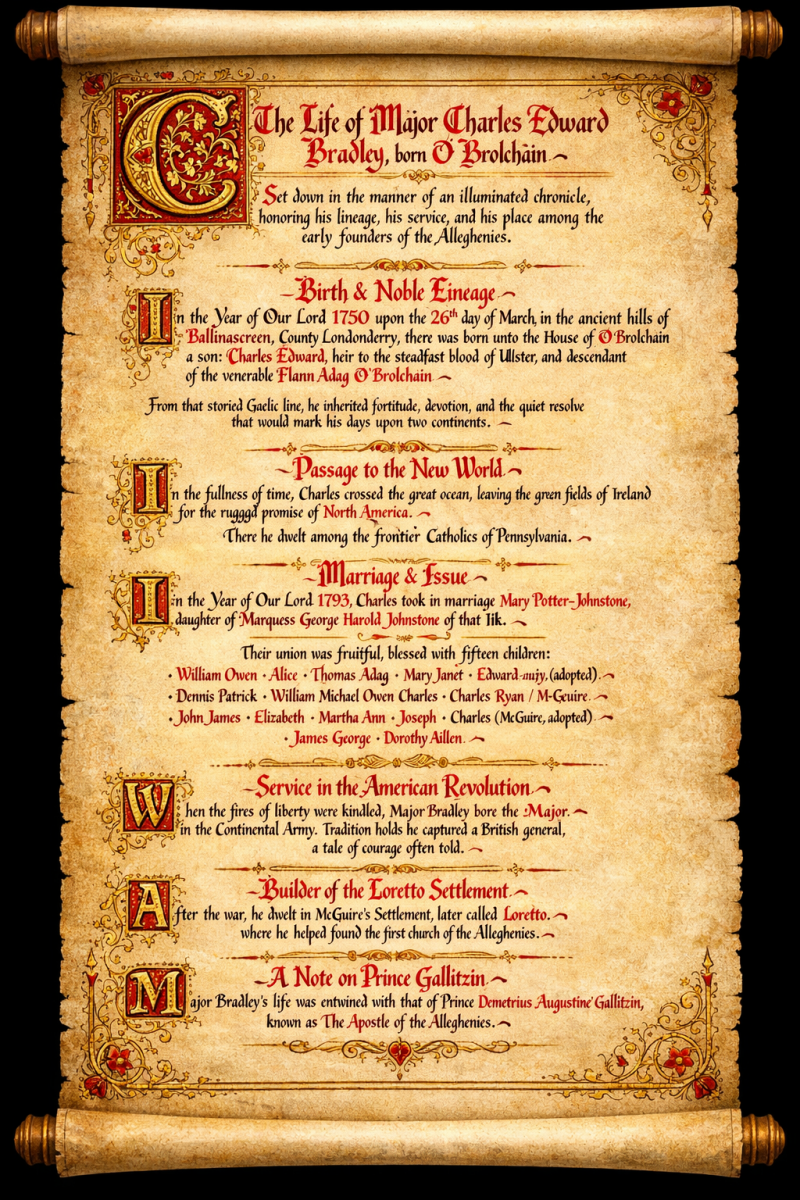
Major Charles Edward Bradley, born Ó Brolcháin on 26 March 1750 in Ballinascreen, County Londonderry, stands as one of the defining patriarchs of the Bradley–Ó Brolcháin line and a foundational figure in the early Catholic frontier of western Pennsylvania. A veteran of the American Revolutionary War, a pioneer of the McGuire’s Settlement that would become Loretto, and a trusted associate of Prince Demetrius Augustine Gallitzin, his life bridges the worlds of Gaelic lineage, military service, and frontier nation‑building. His legacy endures not only through his extensive family and preserved historical documents, but through the community he helped shape—one of the earliest Catholic strongholds west of the Alleghenies. His story forms a cornerstone of the heritage upheld by The Royal House of Bradley.
✦ Major Charles Edward Bradley (born Ó Brolcháin) ✦
1750–1826
Patriot • Pioneer • Founder of the American Branch of the House of Bradley–Ua Bhrolcháin
Bearer of the Princely Blood of the Cenél Eógain
✦ I. Birth, Lineage, and Dynastic Identity ✦
Charles Edward Bradley, born Ó Brolcháin on 26 March 1750 in Ballinascreen, County Londonderry, was the eldest son of Flann Adag Ó Brolcháin, Prince of the Cenél Fearadhaigh and hereditary head of the princely line of Uí Bhrolcháin. Through his father, Charles inherited:
-
the royal bloodline of the Cenél nEógain,
-
direct descent from Eógan mac Néill,
-
and the ancient ecclesiastical prestige of the Uí Bhrolcháin — a house of abbots, bishops, coarbs, scholars, and monastic stewards.
The Uí Bhrolcháin were a princely ecclesiastical dynasty, recognized within the Tanistry of the Cenél nEógain and counted among the royal houses eligible to advise and legitimize kings. Their sovereignty was never surrendered under English rule, and their identity endured through centuries of conquest and colonization.
Charles was born into this legacy — the living continuation of a lineage that had shaped the spiritual and political life of Ulster for nearly a thousand years.
✦ II. Early Life in Ulster ✦
Charles spent his youth in the cultural heartlands of Derry and Tyrone, where the memory of the Uí Bhrolcháin’s ecclesiastical authority remained strong. Though the Gaelic order had been dismantled by the 18th century, the family preserved:
-
their genealogical memory,
-
their princely identity,
-
their ecclesiastical traditions,
-
and their unbroken paternal line.
He grew up in a world where the old Gaelic nobility survived in spirit, even as English law attempted to erase it.
✦ III. Emigration to America ✦
Like many Ulster Gaels facing political pressure and economic hardship, Charles emigrated to North America. He settled among the early Catholic frontier families of western Pennsylvania, joining a community of Irish settlers whose shared heritage, faith, and resilience helped shape the region.
This migration marked the moment when the ancient princely line of the Uí Bhrolcháin crossed the Atlantic, carrying with it:
-
the sovereignty of the Cenél nEógain,
-
the ecclesiastical legacy of Derry and Raphoe,
-
and the unbroken bloodline confirmed today by Y‑DNA (R‑M222 → R‑Z2959 → FTG10651).
✦ IV. Marriage and Family ✦
Charles married Mary Ann Potter‑Johnstone (1757–1817), the daughter of Marquess George Harold Johnstone of that Ilk, linking the Uí Bhrolcháin to Scottish nobility of Dumfries and Galloway.
Together they had 15 children, including:
-
William Owen Bradley (1778–1846)
-
Alice Bradley (1781–1844)
-
Thomas Adag Bradley (1782–1857)
-
Mary Janet Bradley (1783–1853)
-
Edward McGuire Bradley (adopted, 1785–1829)
-
Dennis Patrick Bradley (1787–1857)
-
William Michael Owen Charles Bradley (1792–1849)
-
Charles Ryan Bradley / McGuire (1795–1855)
-
John James Bradley (1796–1876)
-
Elizabeth Bradley (1797–1849)
-
Martha Ann Bradley (1798–1838)
-
Joseph Bradley (1800–1846)
-
Charles Bradley (McGuire, adopted, 1793–1855)
-
James George Bradley (1801–1876)
-
Dorothy Aillen Bradley (1801–1869)
Through these children, the American branch of the House of Bradley–Ua Bhrolcháin flourished.
✦ V. Military Service in the American Revolutionary War ✦
Charles Edward Bradley served as a Major in the Continental Army during the American Revolutionary War. He is historically associated with:
-
Captain Michael McGuire, fellow Ulster Catholic and frontier leader
-
Colonel Thomas Brown, later a supporter of General Washington
-
frontier operations in Pennsylvania
A long‑preserved oral tradition recounts that Major Bradley captured a British general during the conflict. While not fully documented in surviving military archives, the story aligns with the type of engagements common among Continental officers in frontier theatres.
For Charles, the Revolution was more than a military struggle — it was a continuation of the centuries‑long resistance of the Uí Bhrolcháin against foreign domination. In America, he fought the same imperial power that had dismantled the Gaelic order in Ireland.
✦ VI. Pioneer of McGuire’s Settlement inLoretto, Pennsylvania ✦
After the war, Major Bradley settled in McGuire’s Settlement, later known as Loretto. He became one of the founding figures of the early Catholic community in western Pennsylvania, contributing to:
-
the growth of the settlement
-
the construction of the first Catholic church west of the Alleghenies
-
the establishment of a stable frontier community
His home became a centre of Catholic life in the region.
✦ VII. Association with Prince Demetrius Augustine Gallitzin ✦
“The Apostle of the Alleghenies”
Major Bradley was a close associate and friend of Prince Demetrius Augustine Gallitzin, the Russian‑born Catholic priest who founded the Catholic Church in the Pennsylvania wilderness.
Bradley was one of six frontier settlers who helped construct Gallitzin’s first church — a foundational moment in the history of Catholicism in the American interior.
Their partnership reflects:
-
Bradley’s leadership in the frontier Catholic community
-
his commitment to faith and service
-
the continuation of the Uí Bhrolcháin’s ancient ecclesiastical tradition in a new land
✦ VIII. Documents and Historical Artefacts ✦
Major Bradley’s life is preserved through:
-
1798 citizenship papers
-
records from the Cambria County Historical Society
-
family portraits and genealogical documents
-
local accounts referencing his military service and settlement work
These materials confirm his central role in the early history of Loretto and the Catholic frontier.
✦ IX. Death and Legacy ✦
Major Charles Edward Bradley died on 9 April 1826 in McGuire’s Settlement and is buried in St. Michael Cemetery, Loretto.
His legacy is profound:
-
Patriot — a veteran of the American Revolution
-
Pioneer — a founder of the Catholic frontier community
-
Dynastic Patriarch — the father of the American Bradley–Ua Bhrolcháin line
-
Bearer of Sovereignty — the continuation of a princely Gaelic lineage in the New World
Through him, the ancient blood of the Cenél nEógain and the ecclesiastical nobility of the Uí Bhrolcháin entered American history.
✦ X. Closing Reflection ✦
Major Charles Edward Bradley was more than a soldier, settler, or pioneer. He was the living embodiment of a thousand‑year Gaelic dynasty, carrying the sovereignty, faith, and heritage of the Uí Bhrolcháin across the ocean and planting it in new soil. Through him, the princely line of the Cenél Eógain survived conquest, crossed continents, and entered the modern age — unbroken, unbowed, and unmistakably sovereign.