

House Titles


⟦ Codex of Titles and Lineage of the Imperial and Royal House of Bradley ⟧
A Ceremonial Register of the Sovereign House of Baile Uí Bhrolcháin
The White Rod and Gaelic Sovereignty
The White Rod, also called the White Wand, Rod of Inauguration, or Wand of Sovereignty, is the ancient symbol of legitimate Gaelic kingship. Known in Irish as the slat na ríghe or slat tighearnais, it served as the central emblem in the inauguration of a Gaelic king or lord.
Historically, the title Chief was synonymous with Rí (King), Tiarna (Lord), or Captain of his Country, reflecting the fluid hierarchy of Gaelic sovereignty before the collapse of the old order.
The Royal Crown
The Bronze Crown of Brolchán, borne by the Royal Prince and descendant of Suibne Menn (High King of Ireland, d. AD 628), anchors The House of Bradley within the ancient Cenél nEógain lineage of the northern Uí Néill. Suibne, of the Cenél Feredaig, was a great‑grandson of Niall of the Nine Hostages, affirming the House’s ancestral legitimacy.
The Imperial and Royal House of Bradley
A Complete Ceremonial Register of the Sovereign, His Consort, His Issue, and His Line
Within every sovereign tradition, titles serve not merely as marks of honour but as vessels of history, identity, and lawful authority. The Imperial and Royal House of Bradley preserves this principle with deliberate care, maintaining a structured hierarchy that reflects its Gaelic inheritance, its dynastic continuity, and its modern ceremonial role.
This page presents the formal catalogue of dignities, ranks, and styles recognised within the House, each rooted in ancestral precedent, each shaped by the Sovereign’s prerogative, and each contributing to the living order of precedence that guides the House’s public and ceremonial life.
Here, readers will find the historical foundations of sovereignty, the distinctions between royalty, nobility, and gentry, and the rules governing inheritance and styling. Together, these elements form the constitutional fabric through which the House affirms legitimacy, honours service, and upholds the traditions entrusted to it.
TITLES AND SUPERLATIVES OF THE IMPERIAL AND ROYAL HOUSE OF BRADLEY
The following dignities, ranks, and honours constitute the formal structure of precedence within the Imperial and Royal House of Bradley and its affiliated traditions.
Historical Foundations of Sovereignty
Suibne Menn (Suibne mac Fiachnai) — known as “Suibne the Wise, son of Fiachnae” — died in AD 628 and is counted among the High Kings of Ireland. He belonged to the junior branch of the Cenél nEógain, specifically the Cenél Feredaig, named for his grandfather Feredach, a great‑grandson of Niall of the Nine Hostages.
The Bronze Crown of Brolchán and the White Rod (slat na ríghe, slat tighearnais) symbolised the legitimate authority of a Gaelic king or lord. The White Rod served as the central emblem of inauguration and sovereignty.
Historically, the title Chief was synonymous with Rí (King), Ríona (Queen), Tiarna (Lord), or Captain of his Country prior to the collapse of the Gaelic order.
Hierarchy of Titles
👑 THE DEFINITIVE ORDER OF PRECEDENCE — of the Imperial & Royal House of Bradley–Uí Bhrolcháin
Full dynastic hierarchy
THE CROWN (SUPREME SOVEREIGNTY)
- Sovereign Prince — (Rí‑Flaith)
- Sovereign Princess — (Banríona‑Iosóid)
HIGH ROYALTY & SUCCESSION
(The direct line of inheritance.)
- Prince(ss) of Baile Uí Bhrolcháin — Heir Apparent, (Tánaiste)
ROYAL PRINCES & PROVINCIAL PRINCES
(Senior royal blood and provincial sovereignty.)
— European‑Style Royal Titles
- Prince(ss) Dowager
- Prince / Princess — of the Blood Royal
- Prince / Princess Consort
- Princess Royal
- Princes and Princesses — of the House
- Princes and Princesses — of Honour
— Gaelic Royal Titles
- Flaith — Prince of the Blood Royal
- Iosóid — Princess of the Blood Royal
- Ard‑Fhlaith — Senior Royal Dignity
- Ceann Fine — Chief of the Noble Kin
- Toísech — Chieftain
- Flaith Cóicid — Provincial Prince
- Flaith Mór — Great Noble of Royal Blood
- Flaith — High‑Born Noble
HIGH NOBILITY (EUROPEAN & GAELIC)
(The great lords of the realm.)
— European High Nobility
- Duke / Duchess — of the House
- Duke / Duchess — of Territory
- Marquess / Marchioness
- Earl / Countess
— Gaelic High Nobility
- Tiarna / Tighearna — Lord
- Tiarna Mór — Great Lord
- Maer / Maor — Steward
- Aire Ard — High Noble
MIDDLE NOBILITY
(Lesser lords, barons, and service nobles.)
— European Middle Nobility
- Viscount(ess)
- Baron(ess)
- Lord / Lady — of the Court
— Gaelic Middle Nobility
- Aire Tuíseo — Leadership Noble
- Aire Deso — Service Noble
- Tiarna / Tighearna — Lord
LOW NOBILITY
(Hereditary and service dignities.)
— European Low Nobility
- Lord / Lady — of the House
- Baronet(ess)
- Knight / Dame
— Gaelic Low Nobility
- Ridire / Ban‑Ridire
CHIVALRIC & WARRIOR PRECEDENCE
— Chivalric Orders
(Ranked highest to lowest.)
- Knight Grand Collar (KGC) or Dame Grand Collar (DGC)
- Knight Grand Cross (GC) or Dame Grand Cross (GC)
- Knight Commander (KC) or Dame Commander (DC)
- Knight Officer (KO) or Dame Officer (DO)
- Knight (K) or Dame (D)
— Warrior Precedence
- Curadh Mór
- Taoiseach Catha
- Gaiscíoch
- Marcach
- Cliamhain
- Ridire
- Óglach
LANDED & CLAN PRECEDENCE
— Landed Precedence
- Lord of the Manor
- Warden of the Marches
- Chief of the Name
- Elder of the Sept
- Noble Freeman
— Clan Precedence
- Ceann Fine
- Toísech na Críche
- Tánaiste an Chlainne
- Bóaire
- Aire
GENTRY
(The untitled but elevated class.)
- Escuir — Esquire
- Squire / Squireen / Squiress
- Companion of the House
- Mr. / Mrs. / Miss / Ms.
ECCLESIASTICAL OR SACRAL SUPERLATIVES
(Ranked after noble dignities but above offices)
- H.S.E. — His Sacred Eminence
- H.A.S. — His Apostolic Serenity
- Guardian of the Sacred Lineage
- Keeper of the Ancestral Rites
TITLES OF OFFICE WITHIN THE HOUSE
(Non‑noble; precedence internal to the Household)
Highest Officer
Royal Chancellor:
- Royal Chancellor
Offices under the Royal Chancellor:
- Herald of Arms
- Royal Genealogist
Royal Chamberlain:
- Royal Chamberlain
Offices under the Royal Chamberlain:
- Lord High Steward
- Master of the Rolls
- Marshal of the Household
- Clerk of the Court
Secretary of State:
- Assistant Secretary of State
- Ambassadors, Envoys, Attachés, Diplomatic Agents
Keeper of the Codex:
SUPERLATIVES:
I. SUPREME SOVEREIGN SUPERLATIVES
These represent the highest possible exalted styles in world dynastic tradition.
- H.I.M. — His/Her Imperial Majesty
- H.R.M. — His/Her Royal Majesty
- H.I.&R.M. — His/Her Imperial and Royal Majesty
- H.C.M. — His/Her Celestial Majesty
- H.S.M. — His/Her Sacred Majesty
- H.A.M. — His/Her Apostolic Majesty
- H.Ca.M. — His/Her Catholic Majesty
- H.Mo.M. — His/Her Most Majestic Majesty
- H.M.M. — His/Her Most Mighty Majesty
II. IMPERIAL SUPERLATIVES
Used by emperors, empresses, archducal houses, and imperial princes.
- H.I.H. — His/Her Imperial Highness
- H.M.I.H. — His/Her Most Imperial Highness
- H.G.I.H. — His/Her Grand Imperial Highness
- H.S.I.H. — His/Her Serene Imperial Highness
- H.I.&R.H. — His/Her Imperial and Royal Highness
- H.I.&S.H. — His/Her Imperial and Serene Highness
- H.I.&G.H. — His/Her Imperial and Grand Highness
III. ROYAL SUPERLATIVES
Used by kings, queens, royal princes, and royal houses.
- H.R.H. — His/Her Royal Highness
- H.M.R.H. — His/Her Most Royal Highness
- H.G.R.H. — His/Her Grand Royal Highness
- H.S.R.H. — His/Her Serene Royal Highness
- H.R.&S.H. — His/Her Royal and Serene Highness
- H.R.&G.H. — His/Her Royal and Grand Highness
IV. SERENE AND PRINCELY SUPERLATIVES
Used by sovereign or mediatised princely houses.
- H.S.H. — His/Her Serene Highness
- H.M.S.H. — His/Her Most Serene Highness
- H.V.S.H. — His/Her Very Serene Highness
- H.I.S.H. — His/Her Illustrious Serene Highness
- H.G.S.H. — His/Her Grand Serene Highness
- H.P.H. — His/Her Princely Highness
- H.M.P.H. — His/Her Most Princely Highness
V. ARCHDUCAL AND GRAND DUCAL SUPERLATIVES
Used by archdukes, archduchesses, and grand ducal houses.
- H.A.H. — His/Her Archducal Highness
- H.G.D.H. — His/Her Grand Ducal Highness
- H.M.G.D.H. — His/Her Most Grand Ducal Highness
- H.S.G.D.H. — His/Her Serene Grand Ducal Highness
VI. DUCAL, MARGRAVIAL AND COMITAL SUPERLATIVES
Used by dukes, margraves, counts, and equivalents.
- H.D.H. — His/Her Ducal Highness
- H.M.D.H. — His/Her Most Ducal Highness
- H.Mg.H. — His/Her Margravial Highness
- H.C.H. — His/Her Comital Highness
- H.P.C.H. — His/Her Princely‑Comital Highness
VII. GAELIC AND CELTIC NOBLE SUPERLATIVES
Authentic to the Bradley–Ua Bhrolcháin Gaelic royal tradition.
- A.F. — An Flaith (The Prince‑Lord)
- A.A.F. — An Ard‑Fhlaith (The High Prince‑Lord)
- A.R.F. — An Rí‑Fhlaith (The King‑Prince)
- A.A.R.F. — An Ard‑Rí‑Fhlaith (The High King‑Prince)
- A.T. — An Tánaiste (The Heir Apparent)
- A.T.F. — An Tánaiste Flaith (Princely Heir)
- A.B. — An Bóaire (Noble Landholder)
- A.A.B. — An Ard‑Bóaire (High Noble Landholder)
- A.A. — An Aire (Noble Freeman)
- A.A.A. — An Ard‑Aire (High Noble Freeman)
VIII. WESTERN NOBLE SUPERLATIVES
Used in European aristocratic systems.
- H.L. — His/Her Lordship
- H.Ls. — His/Her Ladyship
- H.M.L. — His/Her Most Lordly Grace
- H.G. — His/Her Grace
- H.M.G. — His/Her Most Gracious Grace
- H.I.G. — His/Her Illustrious Grace
- H.E. — His/Her Excellency
- H.M.E. — His/Her Most Excellent Excellency
- H.I.E. — His/Her Illustrious Excellency
IX. ECCLESIASTICAL SUPERLATIVES
Used by religious princes, abbots, bishops, and high clergy.
- H.M.R. — His/Her Most Reverend
- H.R.R. — His/Her Right Reverend
- H.V.R. — His/Her Very Reverend
- H.M.G.R. — His/Her Most Gracious Reverend
- H.P.R. — His/Her Princely Reverend
- H.S.R. — His/Her Serene Reverend
X. COMPOSITE SUPERLATIVES
These combine multiple dignities—ideal for an Imperial and Royal House.
- H.I.&R.M.S.H. — His/Her Imperial, Royal, and Most Serene Highness
- H.I.&R.&G.H. — His/Her Imperial, Royal, and Grand Highness
- H.I.&R.&S.H. — His/Her Imperial, Royal, and Serene Highness
- H.R.&S.&G.H. — His/Her Royal, Serene, and Grand Highness
- H.I.&S.&G.H. — His/Her Imperial, Serene, and Grand Highness
- H.I.&R.&P.H. — His/Her Imperial, Royal, and Princely Highness
XI. SUPERLATIVE FORMS OF ADDRESS (Written and Spoken)
These are the formal superlative phrases used in proclamations and illuminated manuscripts.
- Your Imperial Majesty
- Your Royal Majesty
- Your Imperial and Royal Majesty
- Your Most Serene Highness
- Your Imperial and Royal Highness
- Your Serene Highness
- Your Princely Highness
- Your Grace
- Your Excellency
- Your Most Reverend Grace
- Your Illustrious Highness
XII. UNIQUE SUPERLATIVES RESERVED FOR THE HOUSE OF BRADLEY–UA BHROLCHÁIN
These are legitimate composite forms tailored to the House's dynastic identity.
- H.I.&R.H. Sovereign Prince
- H.M.S.H. Prince of Baile Uí Bhrolcháin (Tánaiste)
- H.R.H. Prince/Princess of the Blood Royal
- H.H. Prince/Princess of the House
- H.S.H. Prince/Princess of Honour
I. ROYAL DIGNITIES
(Those belonging to royalty or princely rank; above all nobility and gentry)
A. Sovereign Titles
- Sovereign Prince / Sovereign Princess (Rí‑Flaith / Banríona‑Iosóid)
-HRH Carl Raymond David Bradley
- Prince / Princess of Baile Uí Bhrolcháin (Tánaiste) — Heir Apparent
-HRH Christina Elisabeth Ann Bradley
- Prince / Princess Consort — Spouse of the Sovereign
-HRH Elke Petra Scherlein- Consort
B. Royal Titles
- Prince(ss) Dowager
-HRH Gerald Paul Bradley
- Prince(ss) of the Blood Royal
1. HRH Princess Christina (Eldest Royal Child — Her line outranks all others)
- HRH Brayden — Eldest grandchild of the Royal House
2. HRH Prince Patrick (Second Royal Child)
- Skylar — Eldest of Patrick’s line
- Bailey
- Harper
3. HRH Prince Shawn (Third Royal Child)
- Mason — Eldest of Shawn’s line
- Sophia
4. Princess Royal
-HRH Kathleen Marie Bradley (Senior Royal Sibling)
- William Albright, (Recognised Cadet Branch).
- Sarah Albright
5. Princes and Princesses of Royal Blood
-HRH Mary Esther Bradley
- Mark E Singer Jr. — Eldest of Mary's line (first marriage)
- Matthew Singer
- Shannon Hollern — Eldest of (second marriage)
- Morgan Hollern
-HRH Barbara Ann Bradley
- Stephanie Stacey — Eldest of Barbara's line (first marriage)
- Joyce Hughes — (second marriage)
-HRH Denise Lynn Bradley
- Theresa Bowman — (only child)
6. Prince(ss)'s of the House
- HH Shannon Hollern (Lifetime Honour)
7. Prince(ss)'s of Honour
- HSH Carol Ann Scott (Lifetime Honour)
8. Toísech — Chieftain
II. NOBLE DIGNITIES
(The aristocracy proper — titled nobility, both Western and Gaelic)
A. High Noble Titles
- Tiarna / Tighearna — Lord
-HRG Carl Raymond David Bradley
- Duke / Duchess
HRG Duke of Ardara, Raphoe, St. Johnston, and Rathmullan, Carl Raymond Bradley
> Duke of Ardara is tied to the Sovereign Prince(ss)
HRG Duchess of Ardara, Raphoe, St. Johnston, and Rathmullan, Elke Petra Scherlein
> Retains Duchess of Raphoe, St. Johnston, and Rathmullan upon death of Sovereign Prince
HRG Duchess of Baile Uí Bhrolcháin, Ballyshannon and Rossnowlagh, Christina E.A. Bradley
> Vacates and assumes Sovereign Prince(ss) position, and new Heir takes these titles
HRG Consort of Ballyshannon and Rossnowlagh, Jeremy M. Horton
HRG Duke of Ballylifin, Gerald Paul Bradley (WR)
HRG Duke of Ballintra, Patrick Ryan Bradley (WR)
HRG Consort of Ballintra, Skylar Ann Webb (WR)
HRG Duke of Buncrana, Shawn Michael-Christopher Bradley (WR)
HRG Duchess of Burtonport, Kathleen Marie Bradley (WR)
HSG Duchess of Churchill, Mary Esther Bradley (WR)
HG Consort of Churchill, Michael Hollern
HSG Duchess of Donegal Town, Barbara Ann Bradley (WR)
HG Consort of Donegal Town, Kenneth Wilt
HSG Duchess of Fintown, Denise Lynn Bradley (WR)
HG Consort of Fintown, Brian Wagner
HG Duchess of the House, Edeltraud Lisbeth Scherlein
HG Duchess of the House, Carol Ann Scott
HG Duke of Shreveport, La. USA, Tony Tremaine Williams
- Flaith — Noble Lord
- Marquess / Marchioness
HG Marchioness of Donegal, Carol Ann Scott
HG Marquess of Eindhoven, Luzt, John Hull Pothoven
HG Marquess of Greencastle, Tony Tremaine Williams
- Tiarna Mór — Great Lord
- Earl / Countess
HRG Earl of Bridgend, Brayden Albert Rettburg
HG William Albright, 1st Earl of the House, (Eldest surviving son of the Princess Royal), (Recognised Cadet Branch).
HG Earl of the House, Brian Bradley, (Recognised Cadet Branch).
HG Countess of Donegal, Carol Ann Scott
HG Countess of the House, Heidi Barbara Hemler-Trotzer
HG Countess of the House, Deanna Wood Priddy
HG Earl of the House, Gregory Fellows
HG Earl of Catherlough, Gregory A Fornbacher
HG Earl of Eindhoven Luzt, John Hull Pothoven
HG Earl of Raeford Manor, Diego Mariano Vilardi
HG Earl of Hampton Downs, Joshua Aaron Hampton
HG Earl of Malin Town, Michael Bradley
- Maer / Maor — Steward or Chief Steward
- Viscount / Viscountess
HG Viscountess of the House, Thelma Jean Bradley, (Recognised Cadet Branch).
HG Viscount of Killybegs, William Scott Bradley
HG Viscount of the House, John Lutz
HG Viscountess of the House, Sabine Raney
HG Viscount of the House, Richard Raney
- Coarb‑Tighearna — Successor ‑ Lord
- Baron / Baroness
HRG Baroness of Ballybofey and Stranorlar (The Twin Towns), Sophia Michelle Bradley
HRG Baron of Bunbeg, Mason Gabriel Bradley
HRG Baroness of Bruckless, Bailey Allisanne Bradley
HRG Baroness of Burnfoot, Harper Lacy Bradley
HRG Baroness of Bundoran, Skylar Louise Bradley
HG Baron of the House, Michael Bradley
HG Baron of the House, Jeffrey Bradley
HG Baron of the House, David Thiess
HG Baron of the House, Martin Lindner
HG Baroness of Laghey, Maria Izabella Branicka
HG Baron of Keithville, Louisiana, Tony Tremaine Williams
HG Baron of Killybegs, William Scott Bradley
HG Baron of Loughanure, Mikhail Freire Figueiredo
B. Lower Noble Titles
- Lord / Lady of the House of Bradley (Noble dignity within the House)
Lady Skylar Bradley
Lady Bailey Bradley
Lady Harper Bradley
Lord Mason Bradley
Lady Sophia Bradley
- Baronet / Baronetess (Hereditary noble dignity)
Sir Manny Pagan
Dame Shannon Hollern
Dame Stephanie Stacey Patterson
- Ridire — Knight / Ban‑Ridire — Dame
Sir William Albright
Dame Sarah Albright
Dame Shannon Hollern
Dame Morgan Hollern
Dame Stephanie Stacey Patterson
Dame Arianna Rose Stacey Patterson
- Knight / Dame of the House (Lower nobility)
Sir Collin P. Bradley
Sir Keith A. Bradley
Sir James M. Bradley
Dame Terrie Bradley
Dame Sherry L. Bradley-Zylak
Dame Sabine Raney
Sir Daniel Kilgore
Sir Brian Bradley, (Recognised Cadet Branch).
Sir David Thiess
Dame Cora Grace Marshall
Sir Mark E Singer Jr
Sir Matthew Singer
Dame Joyce Hughes-Coleman
Sir Torin Kenneth-Knight Coleman
Dame Theresa Althea Bowman
Sir James Tahaney
Sir Richard Raney
- Knight / Dame of the Royal Orders (Chivalric nobility)
Sir Gregory A Fornbacher
Sir William Scott Bradley
Sir Dominick Kidd
Dame Madison Bowser-Kidd
- Commander — For Royal, Merit, Military, and Ecclesiastical Orders or Household Guard
HG Marchioness of Donegal, Carol Ann Scott
HG Marquess of Eindhoven, Luzt, John Hull Pothoven
HG Marquess of Greencastle, Tony Tremaine Williams
- Lord of the Manor (Historic noble dignity, lowest tier of landed nobility)
Lady of Downings, Shannon Hollern
Lord of Dunfanaghy, Shawn Bradley
Lady of Dunkineely & St. John's Point, Sophia Michelle Bradley
Lady of FANAD Peninsula, Skyler Webb-Bradley
Lady of Glenties, Thelma Jean Bradley
Lady of Carrigart, Jennifer Bradley
Lord of Carndonagh, Avinn Michael Horton
Lord of Culdaff, Manny Pagan
Lord of Doochary, David Goodman
III. GENTRY
(The untitled but socially elevated class below nobility)
- Aire — Noble Freeman, Noble Freewoman (upper gentry / lower nobility depending on context)
- Bóaire — Landholder - Upper gentry; historically wealthy freeholders.
- Escuir — Esquire, Esquiress - Classical gentry rank; above squire, below knight.
- Squire / Squireen / SquiressLower gentry; aspirational class serving noble households.
Squire Brian Douglas
Squire Bobby Solomon
Squire Luis Hernandez
Squire Dennis Lendowski
Squire James L Jones
Squire Jeffrey Korte
Squire Jay Shuster
Squire Robert Stewart
Squireen Judith Stewart
Squire Michael Colvin
Squire Mike Hinojosa
- Companion of the House — Non‑ noble honourific
Timothy Casillo
William R. Bates
James F. Bates
Joeseph Bates
David Thiess
Lori Bradley
Erin Bradley
Catalina Valencia Bradley
Daneila Buhs
Kia Uve Buhs
Hailey Haskic
Cathy Irwin-Fornbacher
Jennifer Horton
Mandy Horton
Howard Horton
Barbara J Horton
Seth Barrineau-Marshall
Arianna Rose Stacey Patterson
Torin Kenneth-Knight Coleman
Cora Grace Marshall
Liza T. Fornbacher-Espinoza
Diane Fornbacher-Walls
Michael C. Fornbacher
- Mr. / Mrs. / Miss. / Ms. — Non‑ noble honourific
Mr. Thomas Roehricht
Mrs. Alexandra Kidd
Mr. Marco Andreas Haskic
Mr. Nathanial Kidd
Mr. Ronnie Haskic
Mr. Brian Douglas Kidd
Mr. Christopher Sell
Mr. Darrell Ross
IV. ECCLESIASTICAL OR SACRAL SUPERLATIVES
(Ranked after noble dignities but above offices)
-
-
- H.S.E. — His Sacred Eminence
- H.A.S. — His Apostolic Serenity
- Guardian of the Sacred Lineage
- Keeper of the Ancestral Rites
-
V. TITLES OF OFFICE WITHIN THE HOUSE
(Non‑noble; precedence internal to the Household)
Highest Officer
Royal Chancellor:
-
-
- Royal Chancellor
-
Offices under the Royal Chancellor:
-
-
- Herald of Arms
- Royal Genealogist
-
Royal Chamberlain:
-
-
- Royal Chamberlain
-
Offices under the Royal Chamberlain:
-
-
- Lord High Steward
- Master of the Rolls
- Marshal of the Household
- Clerk of the Court
-
Secretary of State:
-
-
- Assistant Secretary of State
- Ambassadors, Envoys, Attachés, Diplomatic Agents
-
Keeper of the Codex:
Under the Sovereign Prince
Note on Indigenous Honours
“The Sovereign may recognise the dignities of Indigenous Nations, including but not limited to Sachem, Sagamore, Hereditary Chief, Clan Mother, Peace Chief, War Chief, Elder, and Wisdom Keeper, as honours of equal respect within their cultural context, without incorporating them into the internal hierarchy of the House.”
Rules of Inheritance and Styling
All legitimate children of the Sovereign may receive the title of Prince or Princess, though the Sovereign may alter these rules at their discretion.
All children of HRH the Prince or Princess of Baile Uí Bhrolcháin also receive princely titles, as determined by the Sovereign.
The Heir Apparent bears the title HRH the Prince or Princess of Baile Uí Bhrolcháin.
The title Princess Royal is reserved for the eldest female sibling of the Sovereign and is the second‑highest honour in the House.
Other grandchildren of the Sovereign are considered commoners unless elevated by the Sovereign.
Siblings of the Sovereign are styled HRG Duke or Duchess, except the eldest female sibling, who may be granted HRH Princess Royal for life.
If a previous titleholder of Princess Royal is still living, the title remains with them until their passing.
Among the Sovereign’s siblings, only the eldest legitimate male child of the eldest sibling inherits the ducal title; without a male heir, it reverts to the Royal House.
Titles are generally hereditary to the firstborn legitimate male child, unless otherwise decreed.
Titles ranked Knight or Dame and below pass to the eldest child in each generation.
The Sovereign may extend recognition to other noble Houses, Tribes (including Native American Tribes), and global traditions, as well as chivalric, military, ecclesiastical, royal, and honorific orders.
PRINCES AND PRINCESSES OF THE HOUSE
Being the Lawful Definition, Creation, Dignity, and Precedence of the Dynastic Princes of the
Imperial and Royal House of Bradley
I. The Nature of Princely Dignity
-
The Title of Prince(ss) within the Imperial and Royal House of Bradley is a dynastic dignity, deriving solely from the Sovereign Prince as Fons Honorum and Head of the Royal House.
-
This dignity signifies membership in the Sovereign Family, whether by blood, adoption, or elevation by Letters Patent, and is the highest rank within the Royal House beneath the Sovereign Himself.
-
The princely dignity is non‑territorial, non‑political, and ceremonial‑sovereign in nature, representing the ancient rights of dynastic sovereignty preserved within the House.
II. Categories of Princely Rank
The princely dignity shall exist in three distinct and carefully delineated forms:
1. Princes and Princesses of the Blood Royal (Prínsaí na Fola Ríoga)
Those born of the Sovereign Prince or descended in the legitimate line. They bear the style: His/Her Royal Highness (H.R.H.) Their precedence is second only to the Sovereign Prince.
2. Princes and Princesses of the House (Prínsaí an Tí)
Those elevated by the Sovereign Prince through Letters Patent of Dynastic Creation, in recognition of extraordinary service, loyalty, or office. They bear the style: His/Her Highness (H.H.) They are full members of the Royal House, though not of the Blood Royal.
3. Princes and Princesses of Honour (Prínsaí Onóra)
A rare dignity bestowed for exceptional merit, spiritual service, or lifelong devotion to the Sovereign and the House. They bear the style: His/Her Serene Highness (H.S.H.) They are honorary dynasts, without hereditary transmission unless 'expressly granted'.
III. Authority of Creation
-
The power to create, elevate, or confirm a Prince or Princess rests exclusively with the Sovereign Prince as Fons Honorum, and may not be delegated.
-
Such creation must be enacted by:
-
Letters Patent, sealed and signed by the Sovereign Prince,
-
Entry into the Royal Register,
-
Public Proclamation, where appropriate.
-
-
The Sovereign Prince may, at His discretion, grant:
-
Hereditary princely dignity, or
-
Life princely dignity, according to the needs of the House and the merits of the recipient.
-
IV. Rights and Duties of the Princes of the House
All Princes and Princesses of the House shall:
-
Uphold the honour, dignity, and customs of the Imperial and Royal House of Bradley.
-
Serve as representatives of the Sovereign Prince in ceremonial, diplomatic, or charitable functions when called upon.
-
Maintain conduct befitting their station, preserving the integrity of the House.
-
Bear arms augmented with princely insignia as defined by the Heraldic Authority of the House.
-
Enjoy precedence above all nobles, officers, and knights of the House, save only the Sovereign Prince and the Princess Heir.
V. Precedence of the Princely Dignity
The order of precedence among the princely ranks shall be:
-
The Sovereign Prince (of Baile Uí Bhrolcháin)
- The Princess Consort (of Baile Uí Bhrolcháin)
-
The Prince(ss) Heir (Prince(ss) of Baile Uí Bhrolcháin)
-
Princes and Princesses of the Blood Royal (H.R.H.of Baile Uí Bhrolcháin)
-
Princes and Princesses of the House (H.H.)
-
Princes and Princesses of Honour (H.S.H.)
VI. On the Elevation of Officers of the Household
-
High Officers of the Royal Household—such as the Royal Chancellor, Secretary of State, and Royal Chamberlain — may be elevated to princely dignity in recognition of their service.
-
Such elevation shall not alter their office, but shall enhance their ceremonial precedence and dignity.
-
The Sovereign Prince may, at His discretion, grant them the style H.H. Prince/Princess of the House, or in exceptional cases, H.S.H. Prince/Princess of Honour.
VII. On the Transmission of Princely Dignity
-
Princes of the Blood Royal transmit their dignity according to the laws of succession of the House.
-
Princes of the House do not transmit their dignity unless expressly granted by Letters Patent.
-
Princes of Honour do not transmit their dignity under any circumstance.
VIII. On Removal or Forfeiture
-
The princely dignity may be revoked only by the Sovereign Prince, and only for grave cause:
-
Treason against the House,
-
Dishonourable conduct,
-
Renunciation by the holder.
-
-
Revocation shall be enacted by Letters of Forfeiture and recorded in the Royal Register.
IX. Final Clause
Thus is established the lawful, ceremonial, and dynastic framework for the Princes and Princesses of the Imperial and Royal House of Bradley, preserving the dignity of the Sovereign Line and ensuring the orderly governance of the Royal Family in all generations to come.
Closing Statement
In the ordering of titles, dignities, and hereditary honours, the Imperial and Royal House of Bradley affirms a structure rooted in Gaelic sovereignty, dynastic legitimacy, and the enduring customs of noble governance. These ranks do not merely describe precedence—they safeguard continuity, identity, and the ceremonial integrity of the House itself.
Thus, the Titles and Superlatives herein stand as a living charter of honour: a framework upheld by the Sovereign Prince, preserved through lineage, and carried forward in fidelity to the ancient traditions from which this House descends.
Protocols for Formal Address and Correspondence
To maintain the dignity and tradition of the Imperial and Royal House of Bradley, the following protocols for formal address and correspondence are established based on the Codex of Titles and Lineage.
I. Addressing the Sovereign and Consort
When writing to or speaking with the Head of the House and his Princess Consort, the most formal superlatives are required.
- The Sovereign Prince (Prince Carl Raymond Bradley):
- Formal Address: His Imperial and Royal Highness the Sovereign Prince of Baile Uí Bhrolcháin
- Salutation: Your Imperial / Royal Highness
- Closing: I have the honour to remain, Your Imperial and Royal Highness’s most humble and obedient servant,
- The Princess Consort (Princess Elke Petra Scherlein):
- Formal Address: Her Imperial and Royal Highness the Princess Consort of Baile Uí Bhrolcháin
- Salutation: Your Imperial and Royal Highness
II. The Heir Apparent and Senior Princes/Princesses
These protocols apply to the Princess of Baile Uí Bhrolcháin (Christina), the Prince Dowager (Gerald), and the Sovereign's sons (Patrick and Shawn).
- The Heir Apparent:
- Formal Address: Her Imperial and Royal Highness the Princess of Baile Uí Bhrolcháin
- The Prince Dowager:
- Formal Address: His Royal Highness the Prince Dowager
- The Sovereign’s Sons:
- Formal Address: His Imperial and Royal Highness Prince [First Name], Duke of [Territory]
- Salutation: Your Imperial and Royal Highness
III. The Princesses of the Blood (Siblings)
The Sovereign’s sisters hold a unique "double superlative" according to the Codex, reflecting both their royal status and their ducal authority.
- The Princess Royal and Her Siblings:
- Formal Address: Her Imperial and Royal Highness Princess [First Name], Duchess of [Territory]
- Alternative Superlative: Your/Her Imperial and Royal Grace (Often used when emphasizing their role as a Duchess).
- Salutation: Your Imperial and Royal Highness or Your Imperial and Royal Grace.
IV. The Noble and Landed Gentry
For the children of the Princes and Princesses who hold Baronies or Lordships, the address is slightly less formal but still respectful of their noble rank.
- Barons and Baronesses:
- Formal Address: The Right Honorable [Full Name], Baron/Baroness of [Town]
- Salutation: My Lord / My Lady or Lord/Lady [Surname].
- Lords and Ladies of the Manor:
- Formal Address: The Noble [Full Name], Lord/Lady of [Territory]
- Salutation: Lord/Lady [Surname].
V. Summary Table of Styles
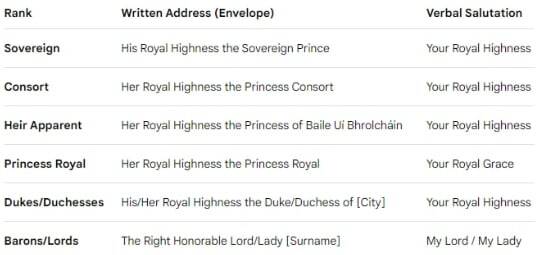
To correspond formally with the Imperial and Royal House of Bradley or the Prince Bradley Foundation, it is important to adhere to the protocols established in the Codex of Titles and Lineage.
Below are two templates: one for a formal Petition for Recognition (such as a request for a title, honor, or heraldic grant) and one for a General Inquiry to the Foundation.
Template 1: Formal Petition to the Sovereign Prince
Use this for matters of honour, requests for chivalric investiture, or genealogical recognition.
[Your Name]
[Your Address]
[Date]
To His Imperial and Royal Highness the Sovereign Prince of Baile Uí Bhrolcháin
The Imperial and Royal House of Bradley
[Official Address/Email]
Your Imperial and Royal Highness,
I have the honour to address you as a devoted supporter of the cultural and humanitarian mission of the Imperial and Royal House of Bradley.
I am writing to humbly petition Your Royal Highness for [mention specific request, e.g., consideration for the Most Royal Order of the House of Bradley / recognition of ancestral lineage]. In support of this request, I wish to highlight [briefly mention your service, merit, or genealogical connection].
It is my sincere desire to contribute to the preservation of the ancient Gaelic heritage that Your Imperial and Royal Highness so graciously stewards. I remain at the disposal of the Imperial and Royal House should any further documentation or information be required.
I have the honour to remain, Your Imperial and Royal Highness’s most humble and obedient servant,
[Your Signature]
[Your Printed Name]
Template 2: Inquiry to the Prince Bradley Foundation
Use this for charitable collaboration, donations, or information regarding the Foundation’s work.
[Your Name]
[Date]
Subject: Inquiry Regarding [Specific Project/Donation]
To the Secretariat of the Prince Bradley Foundation,
I am writing to express my interest in the humanitarian efforts led by the Prince Bradley Foundation, particularly the initiatives established in honour of H.I.R.H. Princess Christine Förnbacher.
I would like to inquire about [state your question, e.g., how to contribute to the Foundation's educational grants/information on upcoming charitable events].
I am deeply moved by the House’s commitment to community service and would welcome the opportunity to support your noble work.
Please let me know the appropriate steps to proceed, or if there is a specific officer I should contact regarding this matter.
Respectfully,
[Your Name]
[Your Contact Information]
Key Mailing Guidelines
- Envelopes: Should be addressed exactly as: His Imperial and Royal Highness the Sovereign Prince Carl Raymond Bradley.
- Signatures: Always sign your name in ink if sending a physical letter; it is a mark of respect in royal correspondence.
- The "Double Superlative": If writing to one of the Sovereign's sisters, ensure the envelope reads: Her Imperial and Royal Highness the Princess Royal, Duchess of Burtonport.