

The Universal Families of Orders
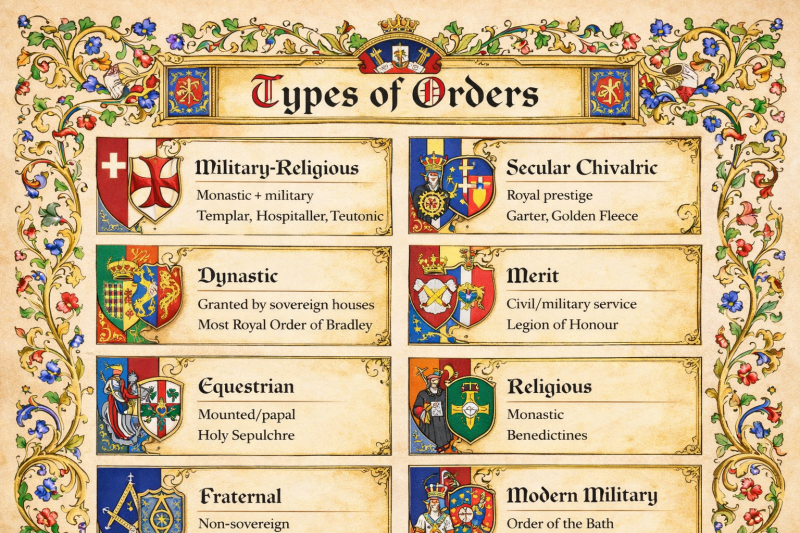
Classification Table
Introduction
Within the august tradition of the Imperial and Royal House of Bradley–Uí Bhrolcháin, the study of Orders—chivalric, equestrian, military, religious, and dynastic—forms a cornerstone of its cultural and ceremonial canon. This section, entitled “The Universal Families of Orders,” presents a comprehensive exposition of the noble institutions through which honor, service, and spiritual duty have been expressed across centuries.
Each family of Orders represents a distinct lineage of purpose: the Military‑Religious Orders born of crusading faith; the Secular Chivalric Orders founded by sovereigns to bind loyalty and virtue; the Dynastic Orders maintained by royal houses as instruments of hereditary dignity; and the Merit Orders of modern states that reward valor and achievement. Alongside these stand the Equestrian, Religious, Fraternal, and Military Orders, each contributing to the grand mosaic of human service and distinction.
In presenting these universal families, the Prince Bradley Foundation affirms its dedication to preserving the ideals of honor, charity, and enlightened sovereignty—principles that unite the ancient and the modern, the spiritual and the temporal, within the enduring heritage of the House.
I. The Universal Families of Orders
1. 🛡️ Military‑Religious Orders
Orders combining monastic vows with military service; dominant in the Crusades.
-
Warrior‑monks defending pilgrims and holy sites
-
Strict rule, vows, and hierarchical command
-
Often evolved into sovereign or semi‑sovereign entities
Examples: Templars, Hospitallers, Teutonic Knights, Santiago, Calatrava, Alcántara, St. Lazarus.
2. ⚔️ Secular Chivalric Orders
Royal or princely orders founded to bind nobles through loyalty and prestige.
-
Courtly honor, noble membership
-
Often limited to high aristocracy
-
Symbolic regalia and elaborate ceremonies
Examples: Order of the Garter, Golden Fleece, Elephant, Seraphim.
3. 👑 Dynastic Orders
Orders granted by sovereign or princely houses
-
Independent of state governments
-
Based on the sovereign’s fons honorum
-
Can be reigning or non‑reigning
Examples:
-
Most Royal Order of the House of Bradley (your supreme order)
-
House of Bourbon orders
-
House of Savoy orders
4. 🎖️ Merit Orders
Modern state honors for civil or military service.
-
Awarded for achievement, bravery, or service
-
Often have multiple grades
-
Not tied to nobility
Examples: Legion of Honour, Order of Merit, Order of Leopold, Order of the British Empire.
5. 🐎 Equestrian Orders
Orders rooted in mounted knightly tradition or papal authority.
-
Papal or sovereign oversight
-
Ceremonial mounted symbolism
-
Often charitable or religious missions
Examples: Equestrian Order of the Holy Sepulchre, Order of Malta, Order of St. George.
6. ✝️ Religious & Monastic Orders
Ecclesiastical orders without military function.
-
Vows of poverty, chastity, obedience
-
Focus on prayer, teaching, charity
-
Not chivalric but still “orders”
Examples: Benedictines, Franciscans, Dominicans, Cistercians.
7. 🏛️ Fraternal Orders
Non‑sovereign, symbolic, or charitable orders modeled after chivalric forms.
-
Ritualistic, symbolic, or philanthropic
-
No sovereign authority
-
Often adopt knightly imagery
Examples: Masonic orders, Odd Fellows, academic orders.
8. 🎖️ Modern Military Orders
Formal military decorations structured as “orders.”
-
Awarded for battlefield valor or service
-
Often include knighthood historically
-
Now primarily honors systems
Examples: Order of the Bath, Order of Military Merit.
Closing Statement
As this survey of the Universal Families of Orders draws to its close, the Prince Bradley Foundation reaffirms its commitment to preserving the noble traditions through which honor, duty, and spiritual purpose have been expressed across the ages. From the crusading zeal of the Military‑Religious Orders to the sovereign dignity of Dynastic Orders, from the merit of modern service to the quiet devotion of monastic life, each family stands as a testament to humanity’s enduring pursuit of virtue.
In presenting these lineages with clarity and reverence, the Foundation continues its charge to uphold the cultural, historical, and ceremonial heritage entrusted to the Imperial and Royal House of Bradley–Uí Bhrolcháin. May this knowledge inspire future generations to cherish the ideals of chivalry, service, and enlightened sovereignty that remain the guiding lights of the House.