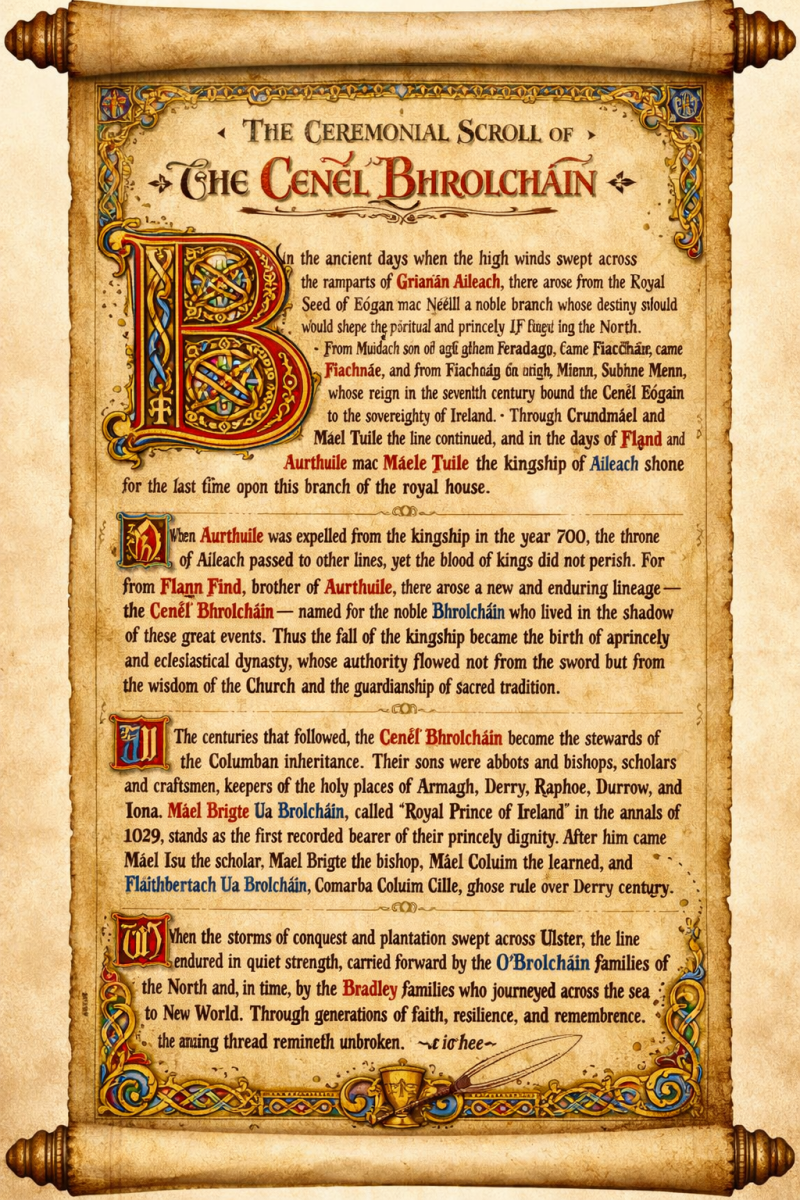
✦ THE HISTORY OF THE CENÉL BHROLCHÁIN ✦
Introduction
The Cenél Bhrolcháin stand among the most distinguished hereditary lines of the Northern Uí Néill — a dynasty born from the royal blood of the Cenél Eógain, shaped by the princely authority of the Cenél Feradaig, and elevated by centuries of ecclesiastical leadership in Armagh, Derry, Raphoe, Durrow, and Iona. Their story begins in the ancient stronghold of Aileach and extends across more than a millennium to the modern restoration of the line in the Imperial and Royal House of Bradley–Ua Bhrolcháin.
From their eponymous founder, Royal Prince Bhrolchán, emerged a lineage that produced kings, abbots, bishops, scholars, craftsmen, and hereditary ecclesiastical stewards — a family whose influence shaped both the political and spiritual life of Ulster. Their history is inseparable from the rise and fall of the Cenél Eógain, the Columban Church, the Bardic schools, and the Gaelic order itself.
This chapter now incorporates the full historical record, including the reigns of Fland and Aurthuile mac Máele Tuile, the Rígdal of Birr, the expulsion of Aurthuile, the branching of the Cenél Fearadhaigh, the Ó Dálaigh and Clancy connections, and the ecclesiastical dominance of the Brolchán line.
I. Origins of the Cenél Bhrolcháin
1. Descent from the Cenél Feradaig
The Cenél Bhrolcháin descend from the Cenél Feradaig, a senior princely branch of the Cenél Eógain. Their ancestral line runs:
Eógan mac Néill → Muirdach → Feradaig → Fiachnae → Suibne Menn (High King, d. 628) → Crundmáel → Máel Tuile → Flann Find → Dichon → Eilgine → Bhrolchán
This lineage places the Cenél Bhrolcháin firmly within the Northern Cenél Eógain, the ruling dynasty of Aileach.
2. The Eponymous Ancestor: Royal Prince Bhrolchán
Bhrolchán lived in the late 7th to early 8th century, during a period of dynastic upheaval. His emergence as the founder of a hereditary line corresponds precisely with the documented elimination of rival Cenél Eógain lines around the year 700 — including the fall of the Suibne Menn succession.
Our document states:
“With their elimination went any claim to the kingship of Cenél nEógain… supporting the ancestral lineage of Cenél Fearadhaigh Brolchain, with both the Y‑DNA haplotree and the lineage branching off about the year 700.”
Thus, Bhrolchán emerges at the exact historical moment when the Cenél Fearadhaigh branch crystallized into a distinct lineage.
II. The Fall of the Suibne Menn Line and the Birth of the Brolchán Branch (681–700)
1. The Reigns of Fland and Aurthuile mac Máele Tuile
The Laud Synchronisms record:
-
Fland mac Máele Tuile — King of Ailech, reigned 12 years
-
Aurthuile (A)Urthuile mac Máele Tuile — his brother, reigned 6 years
Together they ruled 681–700, representing the final generation of the Suibne Menn succession.
2. The Rígdal of Birr (697) and the Law of Innocents
At the great assembly of Birr, organized by Adomnán of Iona, the Law of Innocents was proclaimed. Among the 50 royal guarantors was:
“(A)Urthuile mac Máele Tuile, King of Ailech and Cenél nEógain.”
This confirms Aurthuile’s status as a reigning king and his participation in the highest ecclesiastical legislation of the age.
3. The Expulsion of Aurthuile (700)
The Annals of Ulster (U700.5) record:
“Aurthuile, grandson of Crunnmael, was expelled from the kingship and proceeded to Britain.”
The document emphasizes:
“The Annals state ‘expelled from the kingship’, not put into exile. This expulsion would have been implemented by the church… under Adomnán of Iona.”
This event ended the Suibne Menn succession and forced the surviving line into ecclesiastical prominence.
4. The Death of Flann mac Aurthuile (727)
Aurthuile’s son, Flann, remained in Ireland:
U727.2: “Flann, son of Aurthuile, was killed at the Battle of Druim Fornocht.”
Flann was only about 5 years old when his father was expelled.
His death marks the final extinguishing of the political line — and the transition of the family into ecclesiastical leadership, culminating in the rise of the Brolchán dynasty.
III. The Emergence of the Cenél Bhrolcháin (700–900)
With the fall of the Suibne Menn line, the surviving branch — descended from Flann Find, brother of Aurthuile — became the progenitors of the Cenél Fearadhaigh “BEUS” (Brolchán) lineage.
The document states:
“This aligns with Floinn Find B.est.670… as being the progenitor of the Brolchain family line.”
Thus the Brolchán line emerges directly from the last viable branch of the Cenél Feradaig.
IV. The Ecclesiastical Golden Age (900–1200)
1. The Brolchán–Clann Sionaigh Connection
The historical document provides crucial genealogical evidence:
“The genealogy of the Brolchain’s indicates a close connection with Clann Sionaigh… Maolmhuire (Comharba Padraig 1001–1020) was nephew of Dubhdaleithw (Clan Sionaigh).”
This places the Brolchán family at the heart of the Columban ecclesiastical network.
2. The Great Brolchán Ecclesiastics
The family produced:
-
Mael Brigte Ua Brolcháin (d. 1029) — chief mason of Ireland
-
Máel Ísu Ua Brolcháin (d. 1086) — senior scholar of Ireland
-
Mael Brigte Mac an tSair Ua Brolcháin (d. 1097) — Bishop of Kildare
-
Máel Coluim Ua Brolcháin (d. 1122 & 1136) — bishops of Armagh
-
Flaithbertach Ua Brolcháin (d. 1175) — Comarba Coluim Cille, Abbot of Derry
This era represents the zenith of Brolchán ecclesiastical power.
V. Durrow, the Bardic Schools, and the Ó Dálaigh–Clancy Connection
The document provides a remarkable insight into the 11th–12th century cultural world in which the Brolchán family operated.
1. Durrow Abbey and the Bardic School
Durrow, founded by St. Columba, became a major centre of:
-
Monastic learning
-
Bardic training
-
Ecclesiastical authority
The Brolchán family, as leaders of the Columban Church, were deeply involved.
2. The Norman Destruction of Durrow (1186)
The Annals of Ulster record:
“Hugo de Lacy… was killed… whilst building a castle in Durrow… in reparation to Colum‑cille.”
This event shattered the monastic system and forced the Bardic schools into lay custody.
3. The Ó Dálaigh and Clancy Surname Formation
The historical document explains:
-
The Ó Dálaigh bards originated in Westmeath
-
They dispersed in the 12th century to Clare, Meath, Sligo, Roscommon, Cork
-
The Clancy surname derives from Mac Fhlannchaidh, linked to Breifne and Thomond
-
Both groups interacted with the Columban–Brolchán ecclesiastical network
Most importantly:
“There is a genetic linkage between the Bards and/or Brehons of these Clans and Cenél Fearadhaigh ‘BEUS’ (Brolchain).”
This places the Brolchán family at the centre of the cultural and intellectual world of medieval Ireland.
VI. The Decline of Gaelic Power and the Survival of the Line (1200–1600)
After the fall of the Mac Lochlainn in 1241, the Northern Cenél Eógain lost political dominance. Yet the Brolchán line survived through:
-
Ecclesiastical offices
-
Bardic affiliations
-
Monastic networks
-
Local lordships
Their continuity is preserved in:
-
The O’Brolchain surname
-
The Bradley surname
-
Genealogical manuscripts
-
Y‑DNA evidence aligning with the Cenél Fearadhaigh branch
VII. The Modern Line — From Ulster to America
The line continued through:
-
Flann Adag Ó Brolcháin
-
The Ulster diaspora
-
The Bradley families of Pennsylvania
-
The Bradley line of North Carolina
This culminates in the present head of the house:
His Imperial and Royal Highness Carl Raymond Bradley, Sovereign Prince of the Imperial and Royal House of Bradley–Ua Bhrolcháin.
VIII. Legacy of the Cenél Bhrolcháin
The Cenél Bhrolcháin represent a rare phenomenon in Irish history: a princely house that evolved into a scholarly and ecclesiastical dynasty, producing:
-
Kings of Ailech
-
Royal princes
-
Bishops and abbots
-
Master craftsmen
-
Scholars and poets
-
Custodians of Columban tradition
Their legacy endures today in the restored House of Bradley–Ua Bhrolcháin.
Closing Statement
In the long arc of Irish history, few lineages have endured with such constancy of spirit as the Cenél Bhrolcháin. Born in the courts of Aileach, tempered by exile, refined in the cloisters of Armagh and Derry, and carried forward through the upheavals of conquest and diaspora, this house has never relinquished its identity nor the sacred trust of its ancestors. From kings and princes to bishops, scholars, and custodians of the Columban tradition, each generation bore witness to the resilience of a people who refused to be erased by the turning of ages.
Today, the legacy of the Cenél Bhrolcháin stands not as a relic of the past but as a living inheritance — restored, renewed, and embodied in the Imperial and Royal House of Bradley–Ua Bhrolcháin. In this restoration, the ancient line finds its rightful continuity, and the story of a princely and ecclesiastical dynasty enters a new chapter. Thus the thread first spun in the shadow of Grianán Aileach remains unbroken, carried forward with honour, sovereignty, and remembrance into the world of today and the generations yet to come.